Technical Reference · HYBRID-COPPER-COAX-FIBER
Hybrid Mixed-Media Micro-Coax Capability
Copper + Micro-Coax + Fiber Hybrid Cable Assembly Capability
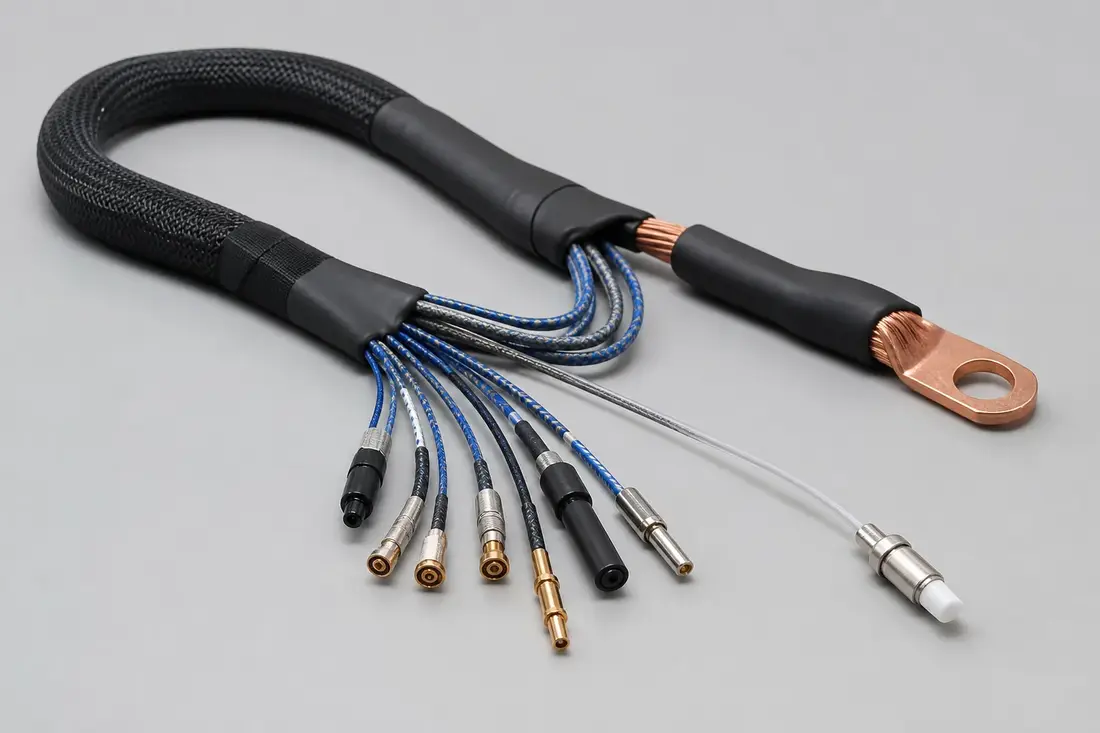
For mixed-media cable assemblies that need power, high-speed signal, and optical channels inside one controlled harness
EDPcable supports hybrid cable assembly programs where copper power conductors, micro-coax high-speed signal paths, and fiber channels must be built inside one harness. The practical scope is structure definition, separated routing, termination sequencing, and traceable records for projects with mixed media, distributed termination points, and inspection requirements across electrical, signal, and optical channels.
Quick Links
QUICK ACCESSStart with the sections closest to the project structure, interface requirements, and validation scope.
Capability Scope Snapshot
Best fit when the system side already knows which channel uses copper, which uses micro-coax, which uses fiber, and where each termination must land. Projects with frequently changing media mixes or bend zones need more definition before release review.
| NO | Review Item | Practical Meaning |
|---|---|---|
| 01 | Capability Definition | Hybrid harness manufacturing and traceable records for one assembly carrying copper power, micro-coax signal, and fiber channels |
| 02 | Relevant Family | Micro-coaxial cable assemblies as the primary family, with possible cooperation across LVDS and medical interconnect projects |
| 03 | Typical Programs | Medical imaging, AR/VR headsets, industrial cameras, and hyperscale BMC or patch projects that combine power, signal, and optical routes |
| 04 | Required Inputs | Copper wire gauge and current, micro-coax AWG and impedance target, fiber count and connector, termination layout, and separation rules |
| 05 | Deliverable Records | Sample approval, separated terminal inspection records, batch labels, shipment files, and optical power spot-check records when agreed |
| 06 | Capability Boundary | No fixed bend radius, impedance data, or optical loss value is claimed without customer drawings, samples, and agreed test scope |
Capability Review Inputs
Use these items as first-round review inputs so the discussion does not rely on the page label alone.
Provide copper gauge and current, micro-coax AWG and impedance, and fiber count and connector.
Include termination distribution for each end of the harness.
Define shared route length, bend zones, shielding, spacing, and sleeve rules.
Describe customer system-side mating or verification expectations.
State sample, validation, pilot, and production quantity expectations.
Customer Pain Points
Hybrid cable assembly projects often fail at the integration boundary rather than at one single media type. The practical challenge is keeping copper, micro-coax, and fiber paths separated, identifiable, and traceable inside one released structure.
Process Flow
Hybrid harness programs should separate input review, structure definition, sample execution, terminal inspection, mating verification, batch execution, and shipment records into visible checkpoints.
| NO | Step | Control Point | Output or Record |
|---|---|---|---|
| 01 | Input review | Termination positions, shared route length, bend requirements, and channel roles | Input checklist and engineering review notes |
| 02 | Structure definition | Separation, shielding, sleeving, and branch rules | Controlled drawing |
| 03 | Sample execution | Copper, micro-coax, and fiber terminations handled separately | Samples and sample approval record |
| 04 | Terminal inspection | Copper ends, micro-coax ends, and fiber ends checked separately | Three-category inspection records |
| 05 | Mating verification | Verification against the customer system-side interface | Termination verification note |
| 06 | Batch execution | Production against the confirmed drawing | Batch labels and process records |
| 07 | Shipment | Packaging, labels, and agreed files completed | COC and shipment documents |
Inspection Checkpoints
Inspection should not collapse all media into one broad pass/fail statement. Copper terminals, micro-coax terminals, fiber terminals, and overall routing each need their own review focus.
| NO | Checkpoint | What To Check | Boundary |
|---|---|---|---|
| 01 | Copper terminal | Termination, crimping, and continuity | Customer acceptance standard |
| 02 | Micro-coax terminal | Stripping window, shield integrity, and termination condition | Drawing-defined requirement |
| 03 | Fiber terminal | End face and connector fit | Optical power spot check unless full inspection is agreed |
| 04 | Overall routing | Separation rules, sleeves, labels, and bend-zone protection | Drawing or sample approval basis |
Deliverable Records
Records should make it clear which channel was checked, which released drawing was used, and how the batch can be traced after shipment.
| NO | Record Type | Use | Boundary |
|---|---|---|---|
| 01 | Sample approval record | Fixes the release boundary | Platform change requires confirmation |
| 02 | Three-category terminal records | Evidence for each media type | Based on customer acceptance criteria |
| 03 | Batch labels | After-sales traceability | Linked to order and shipment records |
| 04 | Optical power spot-check record, if applicable | Optical-channel evidence | Not a default contractual claim unless agreed |
| 05 | COC | Batch release | Not a third-party certification |
Applicable Projects
This capability is most useful where mixed media is a real manufacturing and inspection issue, not where the project only needs a general cable category.
| NO | Applicable Project | How This Capability Helps | Review Risk |
|---|---|---|---|
| 01 | AR/VR headsets | Combines power, high-speed signal, and optical display routes | Tight bend zones and fast prototype revisions |
| 02 | Medical imaging equipment | Keeps imaging signal, power, and optical paths under one drawing basis | Record requirements and release boundaries |
| 03 | Hyperscale BMC or patch projects | Supports compact mixed-media routing | Labeling, termination layout, and batch repeatability |
| 04 | Industrial camera systems | Combines local power, signal, and optical transmission | Connector-side identification and installation fit |
Hybrid Copper, Coax, and Fiber Architecture Matrix
A hybrid assembly is a managed set of different media, each with its own termination, bend, grounding, cleanliness, and test boundary. The architecture and work instructions must keep one medium's termination and handling process from damaging another.
| NO | Architecture Field | Project Definition | Controlled Evidence |
|---|---|---|---|
| 01 | Media inventory | Discrete copper, coax, twinax, fiber, and power elements | Circuit and media schedule |
| 02 | Interface map | Source, destination, connector, and contact for each medium | Hybrid netlist and optical map |
| 03 | Branch geometry | Breakout positions, lengths, exits, and service loops | Dimensioned harness layout |
| 04 | Mechanical hierarchy | Common jacket, sub-bundles, separators, and strain relief | Cross-section and breakout drawing |
| 05 | Grounding | Coax shields, drains, connector shells, and chassis bonds | Electrical ground schedule |
| 06 | Fiber handling | Fiber type, connector, cleanliness, and bend protection | Optical handling instruction |
| 07 | Power segregation | Current paths, heat sources, and separation from channels | Power and routing review |
| 08 | Service boundary | Replaceable branch, full harness, or sealed transition | Maintenance definition |
First-Party Engineering References
- IPC cable and wire harness standards scope
Supports controlled cable-assembly workmanship while optical and RF acceptance still require separate definitions.
Hybrid-Media Failure-Mode Review
Mixed media create interface risks at branch points, shared protection, and final handling. A continuity-only release misses optical cleanliness, coax return path, and mechanical cross-loading.
| NO | Failure Mode | Cross-Media Cause | Control Boundary |
|---|---|---|---|
| 01 | Fiber attenuation change | Copper branch or tie loads the optical bend | Separate bend and retention zones |
| 02 | Coax return-path damage | Breakout preparation removes shield coverage | Control transition geometry and grounding |
| 03 | Electrical miswire | Hybrid connector mapping mixes power and signal contacts | Independent netlist and pin review |
| 04 | Thermal interaction | Power conductor heats adjacent optical or coax media | Review current, bundle, and environment |
| 05 | Contamination | Assembly process soils optical end faces | Separate cleaning and inspection flow |
| 06 | Service damage | Technician pulls one branch through common strain relief | Define branch handling and replacement method |
Hybrid Assembly Verification Plan
The final record is a coordinated package of electrical, RF, optical, dimensional, and handling checks. Each method keeps its own units, reference condition, and acceptance limit.
| NO | Verification Domain | Method | Release Record |
|---|---|---|---|
| 01 | Copper circuits | Continuity, shorts, resistance, and polarity as specified | Electrical test report |
| 02 | Coax channels | Measure the named mode on the released coax BOM and length using the approved fixture, calibration, reference planes, and frequency or rise-time range | Measured result and project acceptance limits |
| 03 | Optical paths | Inspect end faces and measure insertion loss at the named wavelength using the approved launch and reference method | Measured optical result and project acceptance limit |
| 04 | Branch dimensions | Measure breakouts, lengths, exits, and datum positions | Dimensional first-article record |
| 05 | Strain relief | Apply branch-specific mechanical test when required | Load, method, and outcome |
| 06 | Installed fit | Route full assembly through representative hardware | Fit and service approval |
| 07 | Change review | Assess each affected medium after BOM revision | Multi-domain revalidation decision |
Engineering Capability
Hybrid harness engineering focuses on cross-media separation, termination sequence, and bend-zone definition before the sample is treated as the released basis. Cross-family engineering review, drawing control, and documentation practice are covered in the Related Capability Pages below.
Engineering Capability
Review shielding, spacing, sleeving, and shared bend zones together instead of media type by media type.
Define which terminations are built first, which need staged verification, and which require customer system-side mating checks.
Quality and Verification Highlights
Separate copper terminal, micro-coax terminal, fiber terminal, and full-route inspection focus.
Do not claim fixed optical loss, impedance values, or third-party certification without confirmed project evidence.
Evidence Chain
Three-category terminal inspection
Record copper, micro-coax, and fiber terminal checks separately when the project requires mixed-media evidence.
Hybrid Media Records
The hybrid-specific record layer captures the three-media separation, mating, and identification choices that are unique to copper-coax-fiber work. Cross-family file control, batch traceability, and certification practice are summarised in the Related Capability Pages.
Media-separated terminal reports
Support separate copper, micro-coax, and fiber terminal review records so mixed-media evidence does not get blurred at the customer side.
Certifications / Records Visuals
IMAGES · 04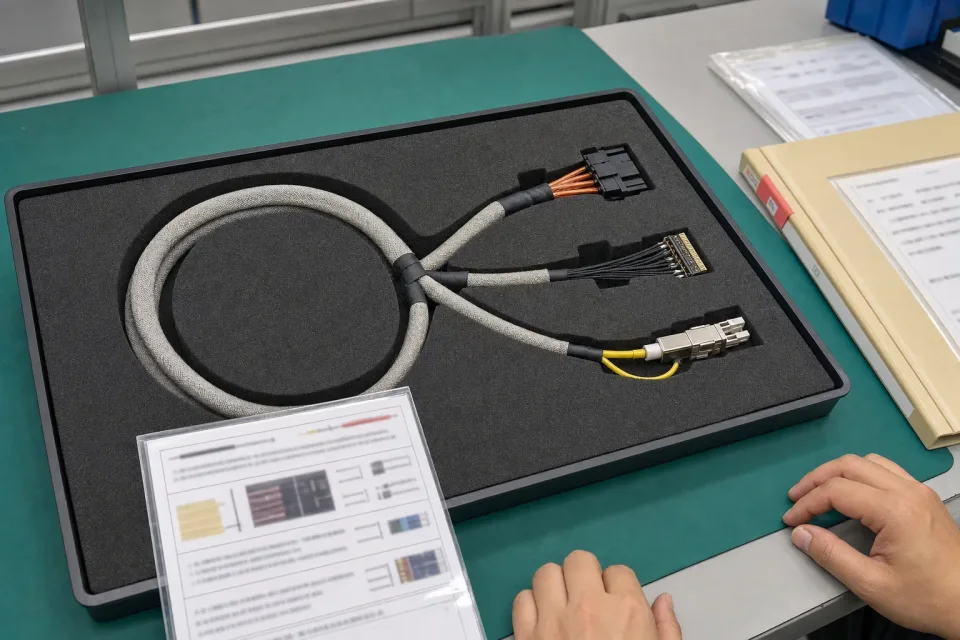
Controlled three-domain termination sample-approval bench for a copper + micro-coax + fiber hybrid harness program, hybrid sample in foam tray with copper power, micro-coax signal, and fiber-optic terminations clearly distinguishable
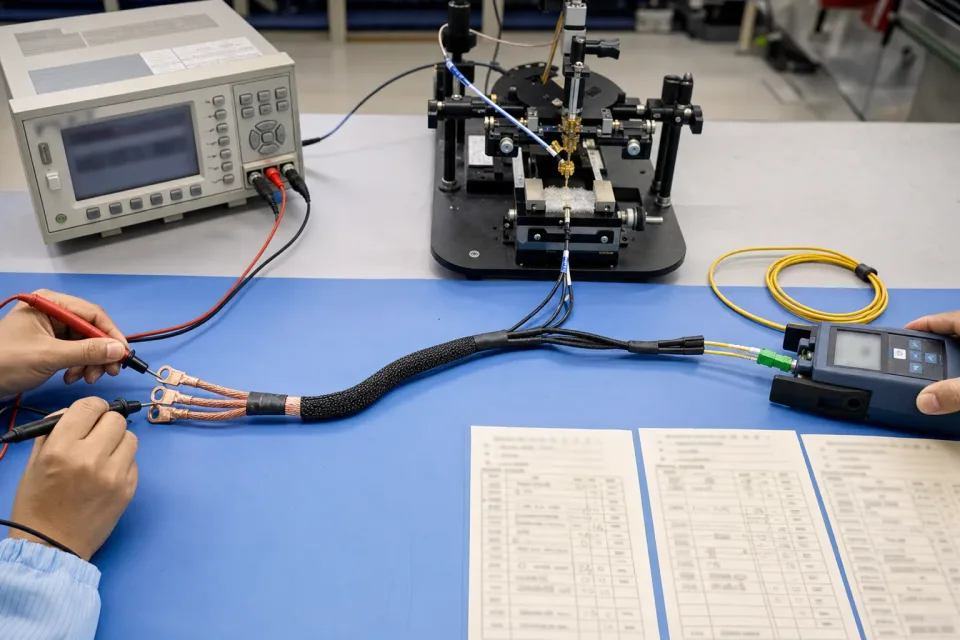
Cross-domain inspection bench for a copper, micro-coax, and fiber hybrid harness with continuity probes, signal fixture, optical power meter, and separate inspection records
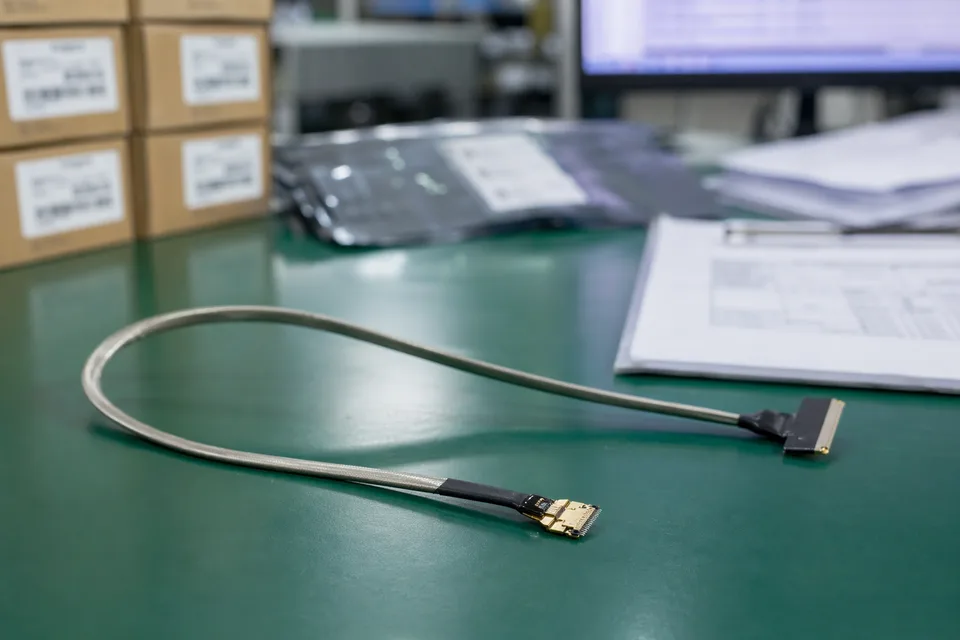
Micro-coaxial batch traceability archive with fine connector lot labels and cable sample visible
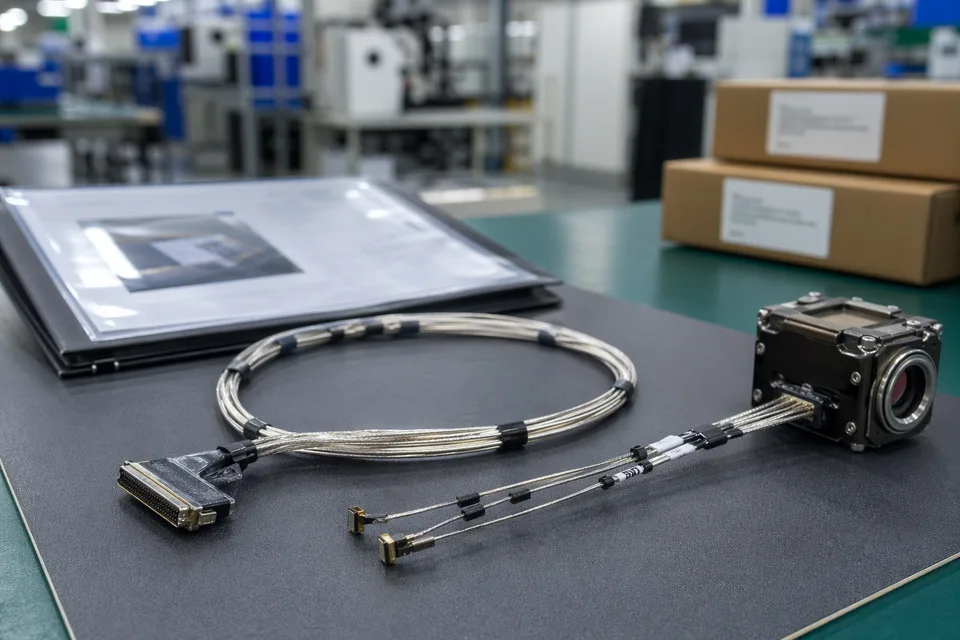
Micro-coaxial released-sample approval folder beside shielded harness and compact module mockup
FAQ
Can copper, micro-coax, and fiber be built inside one cable assembly?
Yes, when termination positions, shared route length, bend zones, and separation rules are clear enough before sampling.
Is optical power checked on every fiber channel?
The default is spot checking. Full inspection needs dedicated scope, workstation time, and cost agreement at RFQ stage.
How are three media types identified at the customer assembly line?
Through batch labels, media identifiers, port numbers, and customer-agreed label rules.
Is the sample lead time longer than a single-media harness?
Usually yes. Mixed-media projects often require one to two extra weeks because termination verification is staged.
Can you define a hybrid structure from an existing sample?
Yes. Provide the physical sample, termination definition, and key dimensions so a controlled drawing can be prepared.