HMLV Cable Assembly Operations
High-Mix, Low-Volume Cable Assembly Manufacturing
Control material lots, line changeovers, test programs, and revision identity across samples, pilots, and repeat low-volume builds.
High-mix, low-volume (HMLV) work is an operating model, not a blanket promise of a fixed low MOQ. Each part number and revision needs a released drawing, kitted material identity, setup verification, the correct fixture or tester program, line-clearance controls, and batch records. Sample, pilot, and repeat-production quantities are reviewed separately because connector packaging, material minimums, tooling, inspection scope, and changeover work set the feasible order boundary.
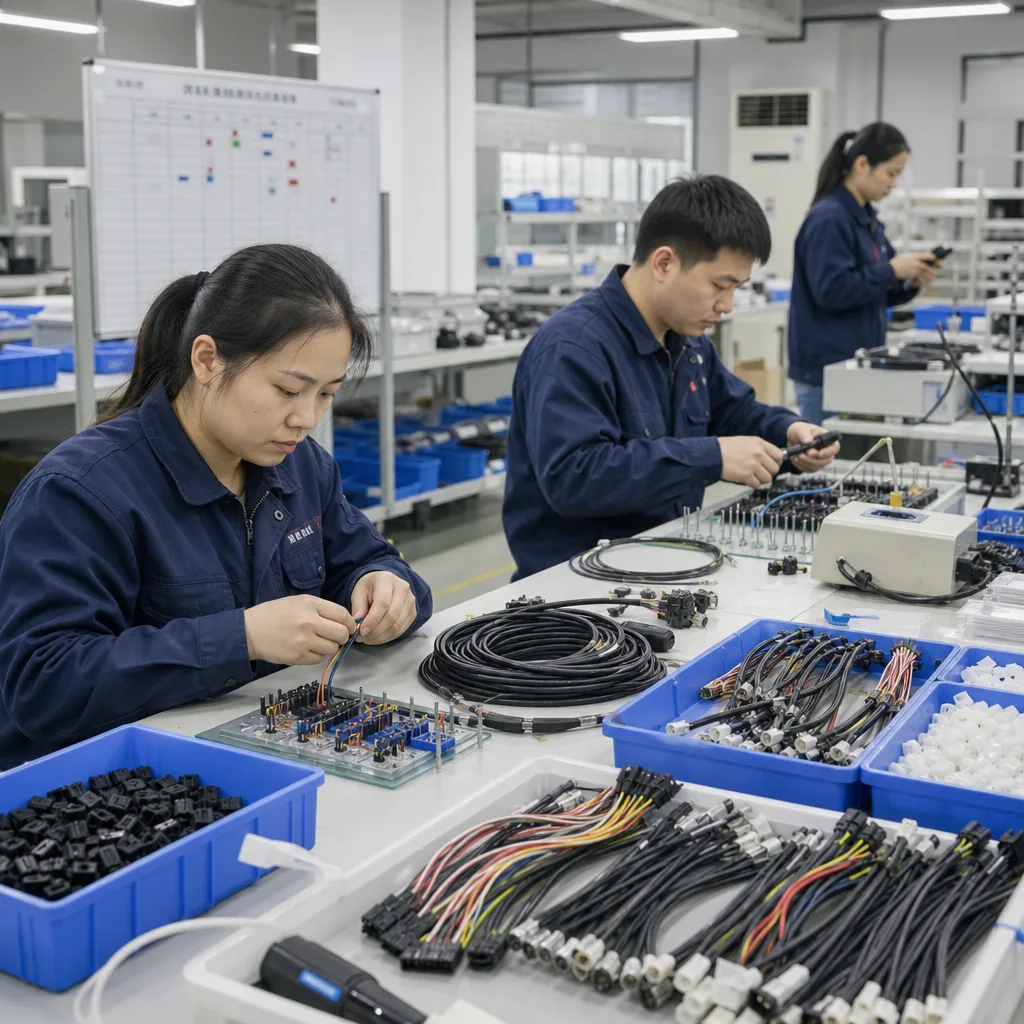
HMLV operating scope
Best fit for programs that move from samples into pilots, order several active part numbers in small repeat batches, or need controlled legacy replacements. It is not a fixed-quantity MOQ offer and does not replace a program-specific capacity, material, tooling, test, or delivery review.
Separate the sample, pilot, first repeat order, and ongoing low-volume demand instead of quoting one undifferentiated annual quantity
Identify material packaging minimums, long-lead items, dedicated tooling, fixtures, test programs, labels, and records by part-number revision
Use line clearance and first-piece verification when switching connector, wire, drawing, fixture, or tester-program revisions
Confirm MOQ, schedule, and commercial boundaries only after BOM, material, setup, inspection, quantity, and revision review
Process Flow
| Step | Station / Action | Control Point | Output Record |
|---|---|---|---|
| RFQ and demand review | Quantity by sample, pilot, first repeat order, and ongoing demand | Separate material minimums, setup work, capacity, inspection, and delivery assumptions | Quotation boundary and staged quantity plan |
| Revision-specific kitting | Released BOM, approved alternates, material lots, labels, and active drawing | One kit identity per part number and revision; shortages and substitutions held for review | Kit status and material-lot record |
| Setup and line clearance | Remove the outgoing kit, tooling, fixture, labels, and tester program; load the incoming release | Verify the station is clear and the incoming setup matches the traveler | Line-clearance and setup-verification record |
| First-piece release | Build and inspect the first piece after setup or revision change | Connector, dimensions, pin map, workmanship, label, fixture, and test-program revision | First-piece or FAI record as agreed |
| Controlled batch build | Execute the released traveler with in-process separation and inspection | Prevent mixed revisions and preserve batch identity through work in process | Traveler, inspection, and electrical-test records |
| Closeout and shipment | Reconcile quantity, deviations, labels, packaging, and required documents | Confirm the shipped batch matches the active order and release | OQC, COC, batch label, and shipment records as agreed |
Inspection Checkpoints
| Checkpoint | What is checked | Record | Limit |
|---|---|---|---|
| Incoming kit | Part number, revision, material identity, quantity, and approved substitutions | Kit or material record | Customer-approved BOM and change rules define acceptance |
| Setup change | Line clearance, tooling, fixture, tester program, labels, and traveler | Setup-verification record | Repeated after relevant setup or revision changes |
| First piece | Connector, pin map, dimensions, workmanship, marking, and defined tests | First-piece or FAI record | Method, sample scope, and acceptance follow the project file |
| In process | Revision separation, key process points, electrical test, and work-in-process identity | Traveler and inspection record | Frequency and sampling plan are project-defined |
| Pre-shipment | Quantity reconciliation, batch labels, packaging, deviations, and required records | OQC and shipment record | Special documents and disclosure scope agreed in advance |
Deliverable Records
| Deliverable Record | Stage | Use | Limit |
|---|---|---|---|
| Staged quantity and quotation boundary | RFQ | Separates sample, pilot, repeat-order, material, tooling, test, and delivery assumptions | The formal quotation and order acknowledgement prevail |
| Revision-specific traveler | Build | Identifies drawing, BOM, material lots, tooling, fixture, tester program, labels, and inspection scope | Format and disclosure follow the agreed project file |
| Setup or line-clearance record | Changeover | Shows the outgoing setup was removed and the incoming release was verified | Required scope depends on the change and customer controls |
| First-piece / FAI record | First build after release or relevant change | Confirms the setup produces the released configuration | Method and acceptance criteria must be agreed |
| Electrical and inspection output | Sample, pilot, or repeat batch | Provides result traceability for the applicable revision and batch | Tests and sampling follow the released control plan |
| COC and batch label | Shipment | Connects the shipped quantity to the order and released batch | COC is not third-party certification |
Applicable Projects
Representative fit scenarios:
Sample-to-pilot display programs where panel, board, connector, and route revisions change before repeat orders
Low-volume medical-equipment internal harnesses that require controlled replacement revisions and specified records
IDC or FFC/FPC programs ordering several pitch, pin-map, length, or connector variants in separate small batches
Micro-coax programs with multiple connector, wire, grounding, and test-program configurations
Related Applications
HMLV manufacturing applies across display interconnect, medical-device internal harness, FFC/FPC, IDC, LVDS, and micro-coax projects when several released variants must be built without mixing material, setup, tester, label, or record identities. It is often paired with rapid prototyping, engineering review, build-to-print, and project-document traceability, but this page owns the production changeover and multi-revision operating controls rather than general MOQ education.
Controls that make HMLV builds repeatable
A traveler or equivalent build record identifies the active drawing, BOM, material lots, tooling, fixture, tester program, labels, and inspection scope
Kits and work-in-process remain separated by part number and revision so a fast changeover does not become a mixed-build risk
Line clearance and first-piece verification confirm the outgoing setup is removed and the incoming setup matches the released file set
Sample approval, pilot learning, deviations, batch identity, and repeat-order changes remain linked to the applicable revision
FAQ
- What is the actual MOQ?
- There is no fixed number. Sample and production quantities are reviewed separately. Connector packaging, material minimums, tooling, test scope, and project complexity determine the quantity confirmed in the quotation.
- How is sample lead time set?
- The sample schedule is confirmed after the drawing, BOM, connector availability, tooling needs, test scope, and approval steps are reviewed. The quotation and order acknowledgement carry the applicable date.
- Can multiple revisions run in parallel?
- Yes. Each revision needs its own drawing, sample confirmation, and label mapping; the full approach is described under Project Documentation & Batch Traceability.
- Does the sample schedule also apply to production?
- No. Production timing is reviewed separately against approved samples, material readiness, quantity, inspection scope, and the active revision plan.
RFQ Inputs
For a new project inquiry, please share:
Part-number list and active drawing / BOM revision for each configuration
Quantity by sample, pilot, first repeat order, and expected reorder rhythm
Connector packaging minimums, approved alternates, customer-supplied material, and known long-lead items
Dedicated tooling, fixtures, tester programs, labels, packaging, and record requirements
Changeover sequence, revision phase-in / phase-out, and any lot-separation rules
Inspection, first-piece, sample approval, deviation, and delivery requirements
Send the part-number mix, revision plan, and quantities by project stage
Include sample, pilot and repeat-order quantities, material constraints, active revisions, required records, test scope, and the delivery sequence. Those inputs establish the real HMLV setup and quotation boundary.