Project Documentation & Batch Traceability
Project Documentation & Batch Traceability
Samples, inspections, and batches stay tied to the same drawing revision.
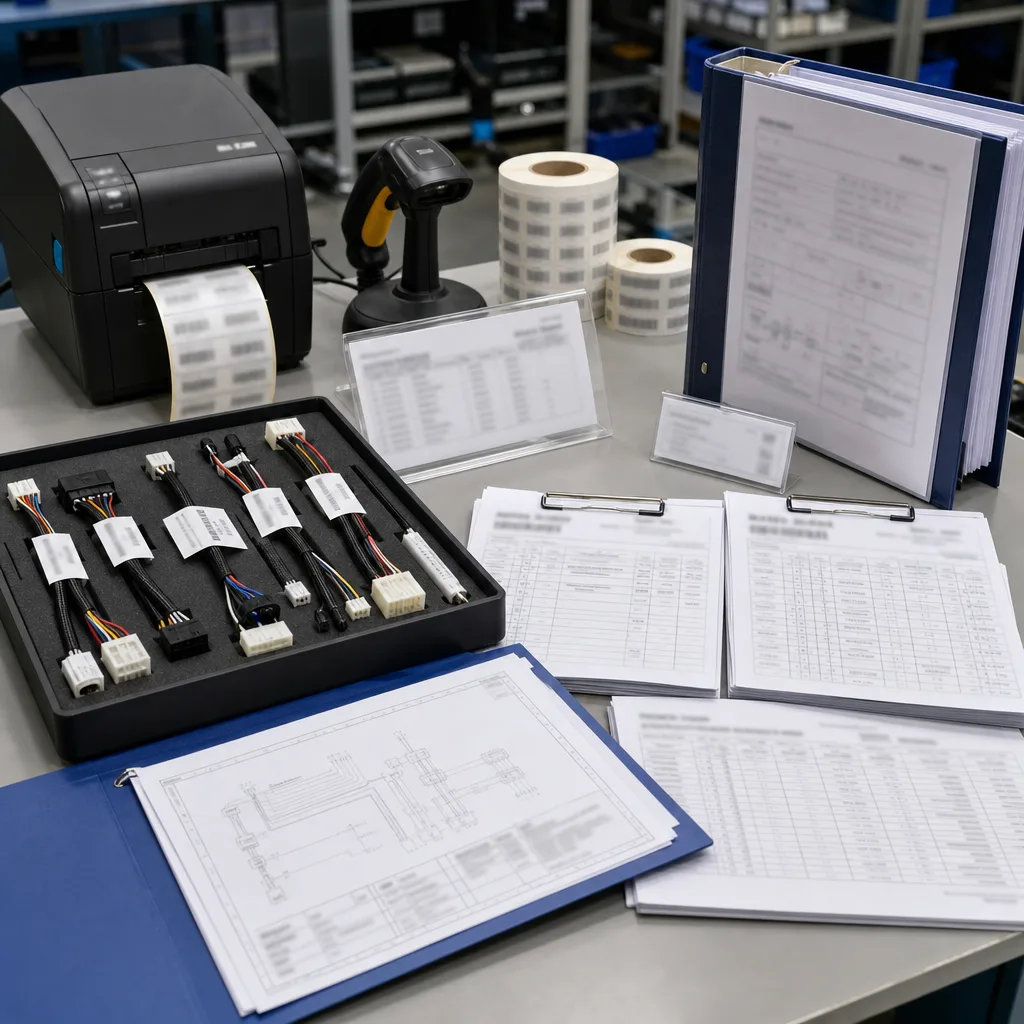
For programs that switch revisions, replace legacy parts, or trace issues back to a specific batch, the hardest part is keeping drawings, samples, inspection records, and batch labels in step. We anchor all four to one controlled drawing, so re-orders and after-sales traceability stay on a single source of truth.
Capability scope
Best fit for projects with connectors already chosen and either a starting drawing or a physical sample — every later sample, inspection, and batch maps back to one defined revision.
Drawings, samples, inspections, and batches all tied to the same revision
Applies to display interconnect, medical device, FFC/FPC, IDC, LVDS, and micro-coax cable projects
Suits revision switches, repeat orders, and after-sales traceability
Record formats and acceptance criteria follow the quality documents both sides agree on
Process Flow
| Step | Station / Action | Control Point | Output Record |
|---|---|---|---|
| Input review | Drawing, sample-confirmation requirements, OQC items, batch label rules, shipment document requirements | Confirm coverage of the current project revision boundary | Input review record |
| Drawing control | Archive current revision + bind version number | Interface references / pin definition / routing notes / bend zones match the same revision | Controlled drawing record |
| Sample confirmation | Sample / key test results / customer confirmation comments | Sample matched to revision + batch binding | Sample confirmation record |
| OQC inspection | Sample / pre-shipment batch OQC | Executed per customer-defined inspection items | OQC inspection report |
| Batch binding | Pre-shipment batch labels + carton marks | Batch number bound to drawing revision / sample confirmation number | Batch label / carton mark |
| Shipment traceability | Shipment documents + COC | Documents return to the same revision | COC + shipment documents |
Inspection Checkpoints
| Checkpoint | What is checked | Record | Limit |
|---|---|---|---|
| Incoming / sample match | Interface model / pin / routing / appearance | Incoming record or sample photos | Customer-supplied part standards confirmed in advance |
| In-process check | Key dimensions / termination / routing / marking | Sampling table / inspection record | Sampling ratio per project definition |
| Pre-shipment confirmation | Labels / packaging / documents | Carton marks and shipment record | Special documents agreed in advance |
Deliverable Records
| Deliverable Record | Stage | Use | Limit |
|---|---|---|---|
| Sample confirmation record | Sample stage | Locking the release boundary | Platform changes require re-confirmation |
| Inspection report | Sample / production | Evidence of key inspection items | Inspection content per project definition |
| FAI | First article / pilot | Aligning first-article structure and dimensions | Needs customer-confirmed standard |
| COC | Batch shipment | Batch release | Not equivalent to third-party certification |
| Batch label / carton mark | Production | After-sales traceability | Must correspond to order / shipment records |
| Controlled drawing | Ongoing | Revision traceback | Customer drawing IP owned by the customer |
Applicable Projects
Representative fit scenarios:
Revision drawings + interface records for multi-version display projects (eDP 30-pin / 40-pin, LVDS 20-50-pin, etc.)
Controlled pin-sequence and labeling-rule records for patient monitoring / diagnostic equipment
Controlled pitch and structure records for ribbon IDC / FFC-FPC
End / shield process records for micro-coax projects
Related Applications
These application families and child pages often involve drawing revisions, sample approvals, OQC records, batch labels, or shipment-side file matching. Use them to enter the specific product direction, then confirm record format, inspection items, and traceability boundaries against the real project.
Why EDPcable
Display interconnect, medical device, FFC/FPC, IDC, LVDS, and micro-coax cable projects run through the same documentation flow
Low-MOQ entry with 1-2 week samples and 3-4 week production keeps revision switches workable
A dedicated project team coordinates the initial review, day-to-day files, and revision handling
Auditable deliverables on request: COC, FAI, batch labels, and shipment records
FAQ
- Does your COC count as a third-party certificate?
- No. The COC is EDPcable's own batch release statement showing the batch matches the agreed project documents. For IPC, ISO, or similar third-party certificates, see the dedicated capability pages.
- We don't have the original drawing — can you still help?
- Yes. We can derive a controlled drawing from a physical sample and key dimensions; both sides confirm it before production batches reference it.
- Can the batch label format follow our internal system?
- Yes. Label content, layout, and scan-code format follow what you specify; the labeling rules need to be locked in during the project setup stage.
- What does the OQC report cover?
- Whatever inspection items you define. The default set covers continuity, short/open, key dimensions, and visual checks; special items should be agreed upfront.
RFQ Inputs
For a new project inquiry, please share:
Current project revision drawing (or physical sample)
Sample confirmation requirements (quantity / key inspection items / confirmation form)
OQC item list (or reference standard)
Batch label rules (format / scan code / layout)
Shipment document requirements (COC / FAI / inspection report)
Batch rhythm and multi-version expectation
Send the project files or a physical sample — we fold it into the document-controlled workflow
One controlled drawing, sample confirmations, and batch records that line up gives multi-revision programs a single anchor for switches and traceability.