Technical Reference · RF-IMPEDANCE-TESTING
Micro-Coax RF Testing Capability
TDR and VNA Testing for Released Micro-Coax Assemblies
Agree the measured channel, mode, fixture, reference plane, stimulus, limits, and sample scope before testing
EDPcable supports project-defined TDR and VNA evidence after the released interface and measured channel are clear. The test request must name single-ended or differential mode, target and tolerance, fixture and calibration or de-embedding approach, reference planes, rise time or frequency range, termination, measurement window, sample plan, acceptance rule, and report format. Results apply only to that setup and specimen revision.
Quick Links
QUICK ACCESSStart with the sections closest to the project structure, interface requirements, and validation scope.
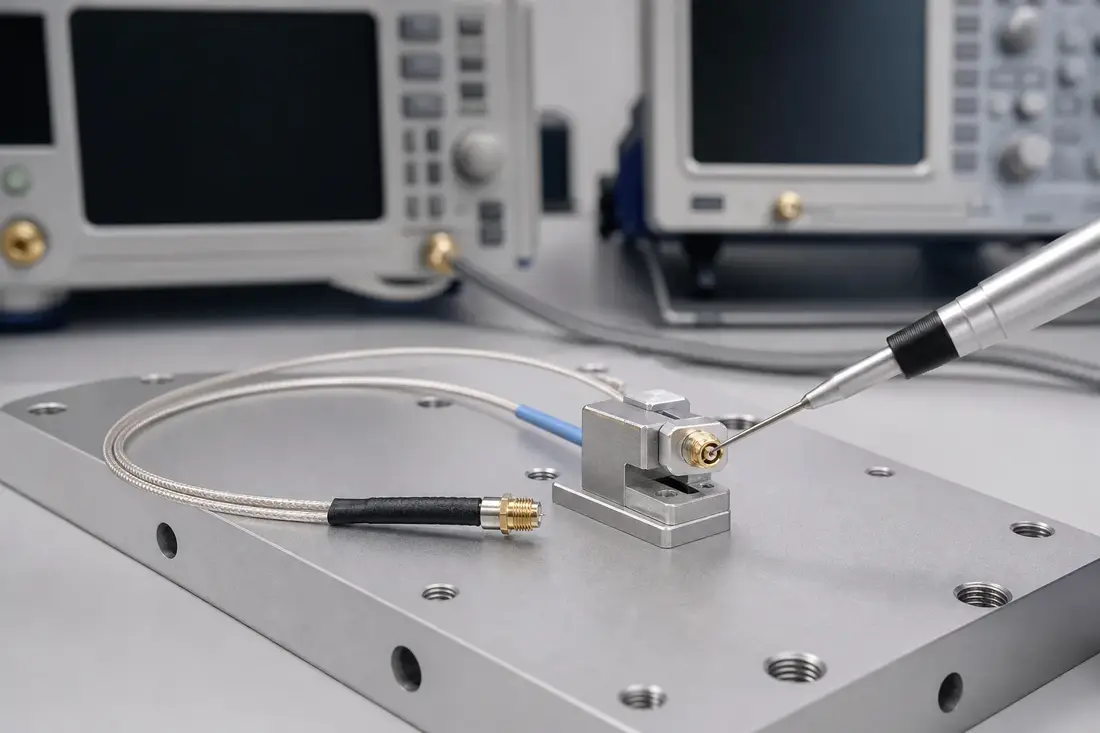
Controlled Test Scope
Use this page when the system owner can define the measured channel and numerical acceptance rule. If the interface target, cable construction, or reference plane is still open, those design decisions precede a meaningful report.
| NO | Review Item | Practical Meaning |
|---|---|---|
| 01 | Capability Definition | Project-specific micro-coax impedance testing, TDR time-domain reflection checks, VNA frequency-domain response checks, and termination consistency verification |
| 02 | Relevant Family | Micro-coaxial cable assemblies, with overlap into LVDS and high-speed FFC/FPC review when required |
| 03 | Typical Programs | 50-ohm single-ended, 75-ohm video, or 100-ohm differential examples when the released interface specifies those targets |
| 04 | Required Inputs | Target impedance and tolerance, test method and frequency range, fixture and de-embedding approach, reference plane, termination type, sample quantity, and sampling ratio |
| 05 | Deliverable Records | Sample impedance report, termination consistency record, batch sampling report, and raw TDR/VNA data when agreed |
| 06 | Capability Boundary | No fixed impedance value, yield, or full-band response is claimed beyond the agreed fixture, method, reference plane, frequency range, and sample scope |
Capability Review Inputs
Use these items as first-round review inputs so the discussion does not rely on the page label alone.
Define measured channel, single-ended or differential mode, target, tolerance, and acceptance window.
Define TDR rise time or VNA frequency range, fixture, calibration or de-embedding, reference planes, and measurement window.
Provide connector and termination definition, cable construction, pin map, length, harness revision, and operating environment.
State sample count and sampling rules for first article, pilot, production, and change-triggered verification.
Specify trace or S-parameter format, cursor data, metadata, raw-data handoff, review owner, and required date.
Customer Pain Points
RF-sensitive micro-coax programs need more than a working sample. They need a test boundary that connects impedance targets, fixtures, termination condition, records, and later batch sampling.
Process Flow
Impedance testing should move through requirement review, fixture preparation, sample testing, termination consistency review, production sampling, deviation handling, and shipment records.
| NO | Step | Control Point | Output or Record |
|---|---|---|---|
| 01 | Test requirement review | Impedance target, tolerance, frequency range, and termination type | Test input checklist |
| 02 | Fixture preparation | Match fixture and interface to the cable termination | Fixture note |
| 03 | Sample testing | TDR or VNA sample test according to scope | Sample impedance record |
| 04 | Termination consistency | Compare multiple pieces in the same batch or sample set | Termination consistency record |
| 05 | Production sampling | First/last piece or agreed sampling ratio | Sampling report |
| 06 | Deviation handling | Return to process review if results move outside the agreed window | Process review record |
| 07 | Shipment confirmation | Include agreed reports with shipment documents | COC and test report |
Inspection Checkpoints
The check point is not just whether a curve appears on a screen. Test method, fixture condition, termination consistency, and acceptance window must be clear before results can support release.
| NO | Checkpoint | What To Check | Boundary |
|---|---|---|---|
| 01 | Sample TDR | Impedance curve against agreed tolerance | Rise time, reference plane, fixture, and acceptance window follow the project agreement |
| 02 | Sample VNA, if applicable | S-parameter response | Frequency span, calibration, reference plane, fixture, and requested S-parameters are agreed before test |
| 03 | Termination consistency | Comparison across pieces or ends | Sampling ratio follows project definition |
| 04 | Production sampling | First/last pieces and extra checks when abnormal | Does not replace customer system-level verification |
Deliverable Records
Reports and raw data should identify sample number, test condition, acceptance window, and the drawing or revision being checked.
| NO | Record Type | Use | Boundary |
|---|---|---|---|
| 01 | Sample impedance report | Sample release support | Test conditions travel with the report |
| 02 | Termination consistency record | Evidence of same-batch variation | Acceptance follows customer criteria |
| 03 | Production sampling report | Batch release support | Sampling ratio follows agreement |
| 04 | Raw TDR/VNA data, if applicable | Customer internal review | File format is agreed project by project |
| 05 | COC | Batch release | Not a third-party certification |
Applicable Projects
Use this capability when signal performance evidence is part of the release boundary, not when the project only needs a general micro-coax overview.
| NO | Applicable Project | Typical Impedance Concern | Review Focus |
|---|---|---|---|
| 01 | Medical imaging video assemblies | 75 ohm video path stability | Test report, fixture condition, and batch sampling |
| 02 | AR/VR headset signal routes | High-density signal route consistency | Termination repeatability and shielding context |
| 03 | Industrial camera micro-coax | 50 ohm RF path review | Connector interface and TDR curve boundary |
| 04 | Data center differential routes | 100 ohm differential stability | Sampling strategy and batch records |
| 05 | Replacement programs | Old sample impedance confirmation | Reverse definition and released drawing linkage |
RF and Impedance Test Definition Matrix
An impedance value is incomplete without mode, tolerance, stimulus, fixture, reference plane, measurement window, sample scope, and acceptance rule. These fields are agreed before the first report is generated.
| NO | Test Variable | Required Definition | Why It Changes the Result |
|---|---|---|---|
| 01 | Target | Single-ended or differential impedance and allowed window | Sets the measured quantity and limit |
| 02 | Channel scope | Bulk cable, terminated assembly, pair, or full route | Defines included discontinuities |
| 03 | Stimulus | Rise time, bandwidth, or frequency range | Controls spatial and spectral sensitivity |
| 04 | Fixture | Adapter, launch, probe, and calibration structure | Adds loss and reflection unless characterized |
| 05 | Reference plane | Physical point where measurement begins and ends | Determines which transitions are included |
| 06 | Measurement window | Cable region, connector exclusion, or gated segment | Prevents ambiguous curve reading |
| 07 | Sampling | Sample count, first article, lot frequency, or full scope | Defines production evidence coverage |
| 08 | Report format | Trace, cursor data, S-parameters, limits, and metadata | Makes results reviewable and repeatable |
First-Party Engineering References
- Tektronix TDR test primer
Explains DUT fixtures, reference effects, differential TDR, multiple reflections, and impedance-profile interpretation.
- Keysight high-precision TDR application note
Covers measurement-system limitations and techniques for removing fixture effects.
RF Measurement Failure-Mode Review
A clean-looking trace can still be non-comparable when fixtures, reference planes, windows, or cable states differ. Measurement control is part of the test evidence.
| NO | Failure Mode | Measurement Cause | Required Control |
|---|---|---|---|
| 01 | Fixture-dominated result | Adapter reflection obscures the assembly response | Characterize or de-embed agreed fixture |
| 02 | Wrong impedance interpretation | Single-ended and differential modes are confused | Name mode and channel topology |
| 03 | Non-comparable traces | Reference plane or window changes between samples | Lock setup and saved state |
| 04 | False pass | Average value hides a localized discontinuity | Define cursor regions and peak rules |
| 05 | Production drift missed | Sample plan excludes setup or termination changes | Tie sampling to risk and change triggers |
| 06 | Overstated capability | Instrument bandwidth is quoted as harness performance | Report only measured DUT conditions |
Controlled RF Test Execution Plan
The execution record preserves calibration state, fixture identity, specimen revision, environmental condition, raw data, and decision limits so another reviewer can understand what passed.
| NO | Execution Step | Control | Evidence |
|---|---|---|---|
| 01 | Setup approval | Record instrument, ports, fixture, cables, and software state | Test setup sheet |
| 02 | Calibration | Apply method appropriate to the agreed reference plane | Calibration status and timestamp |
| 03 | Baseline | Measure reference or golden structure when defined | Baseline trace or S-parameters |
| 04 | Specimen identity | Link cable BOM, length, connectors, and revision | Sample identification record |
| 05 | Data acquisition | Use fixed stimulus, window, averaging, and limit settings | Raw and processed files |
| 06 | Disposition | Compare agreed features to acceptance window | Pass, fail, and reviewer signoff |
| 07 | Production linkage | Apply approved sampling and deviation escalation | Lot-level RF summary |
Engineering Capability
RF testing value comes from connecting the impedance target, micro-coax selection, termination method, fixture and de-embedding setup, reference plane, frequency range, sample scope, and acceptance window before results are treated as release evidence. Cross-family engineering review, drawing control, and documentation practice are covered in the Related Capability Pages below.
Engineering Capability
Review impedance target against micro-coax selection and termination method before sampling.
Check whether test fixture and interface may introduce reflection that hides the true cable result.
Quality and Verification Highlights
Compare termination consistency before blaming the cable route or fixture alone.
Avoid fixed frequency, yield, or full-band claims unless the project scope and evidence support them.
Evidence Chain
Sample impedance report
Records sample number, method, setup, acceptance window, and result boundary for customer review.
Termination consistency record
Compares multiple samples or ends to show whether termination execution is stable enough for the program.
RF Testing Boundaries
The RF-specific evidence layer captures impedance/TDR/VNA records and testing boundaries that are unique to this capability. Cross-family file control, batch traceability, and certification practice are summarised in the Related Capability Pages.
Sample impedance test report
Supports sample approval with the agreed method, setup, and acceptance window.
Raw TDR or VNA data
Can be provided when file format and data handoff are agreed before testing.
Certifications / Records Visuals
IMAGES · 04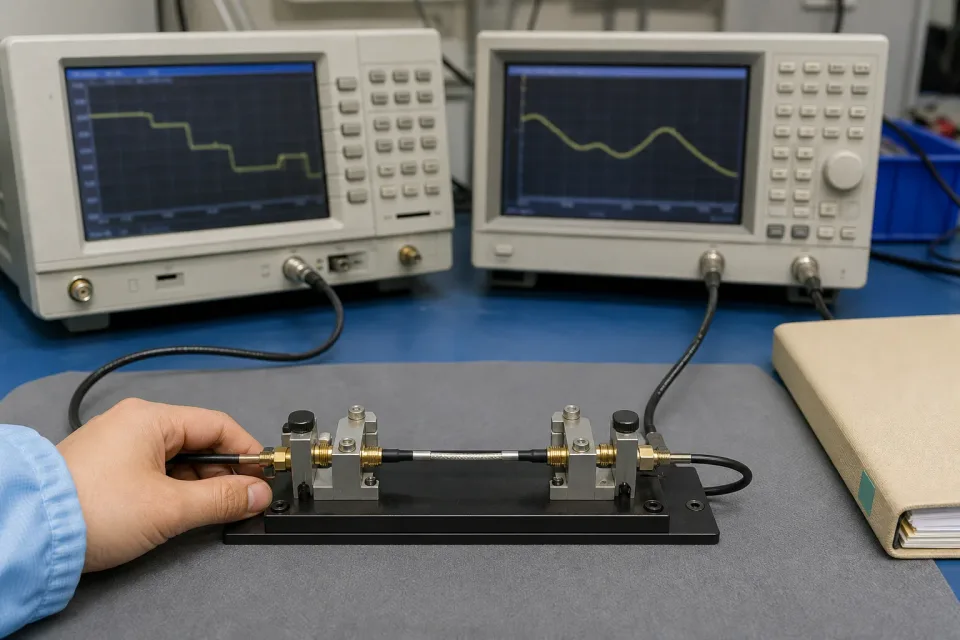
RF impedance test station for a micro-coax program with sample fixture, calibration reference, bench instruments, and controlled test parameters
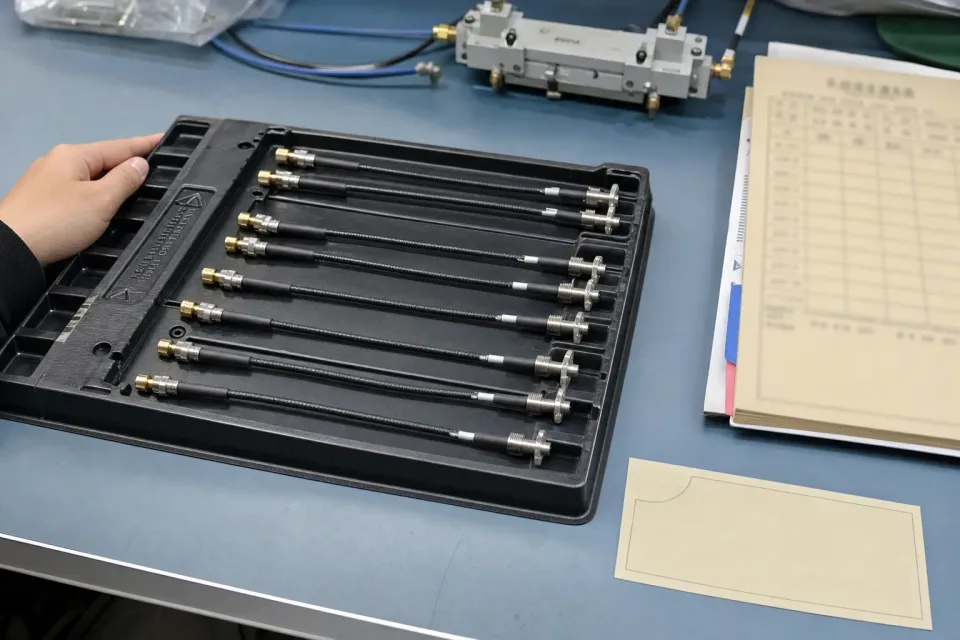
Lot tray of micro-coax test samples with termination-consistency records, batch identification, and calibration fixture
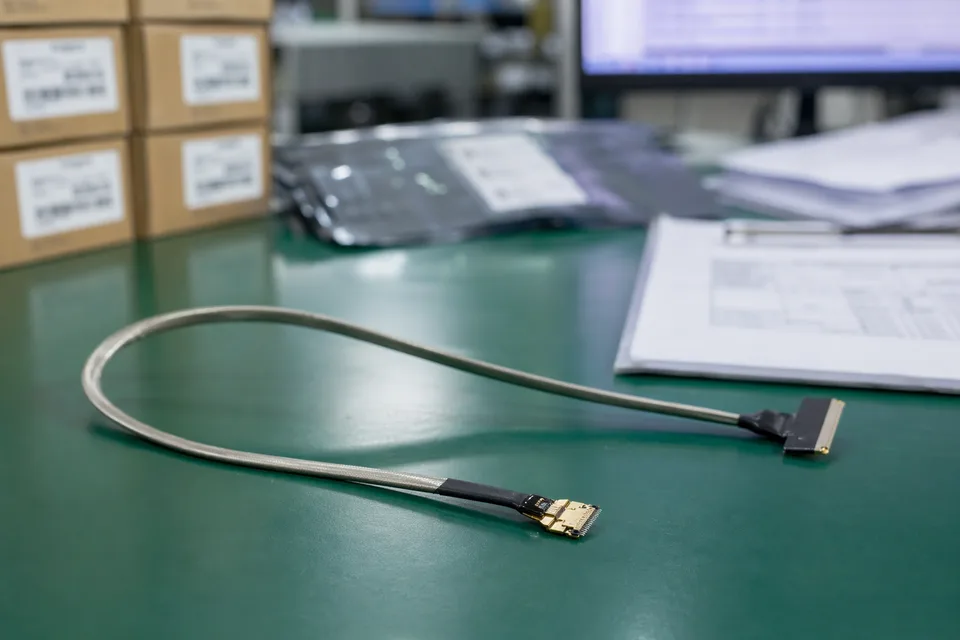
Micro-coaxial batch traceability archive with fine connector lot labels and cable sample visible
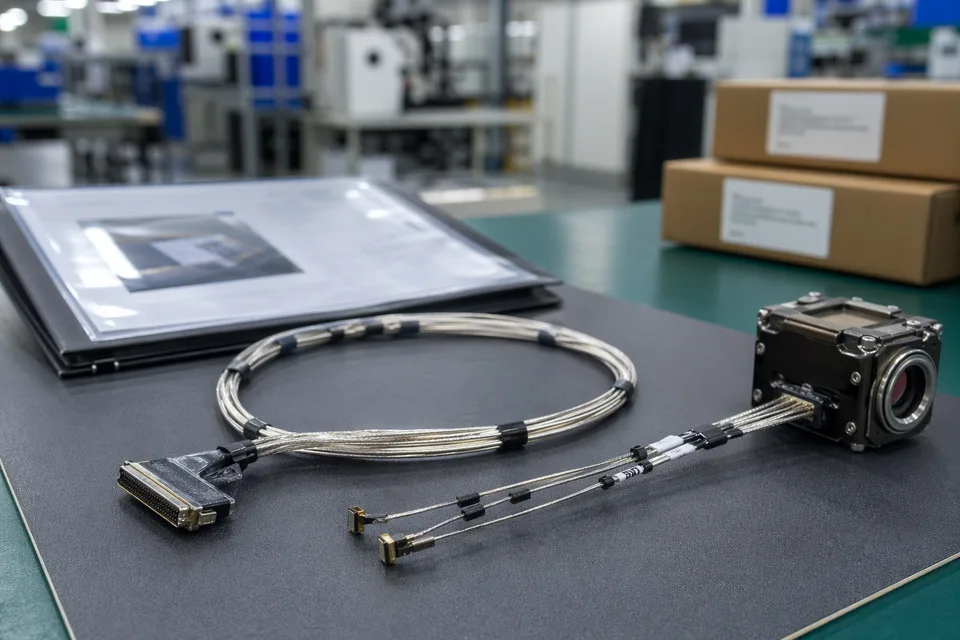
Micro-coaxial released-sample approval folder beside shielded harness and compact module mockup
FAQ
Is RF impedance checked on every piece or by sampling?
Default support is usually sample testing plus production first/last piece sampling. Full inspection needs dedicated scope, workstation time, and cost agreement.
What is the highest test frequency you can cover?
It depends on the equipment and fixture combination confirmed for the project. Higher frequency work requires agreed test conditions.
Can the report support customer internal review?
Yes, when the report format, sample number, test condition, impedance curve, and acceptance window are agreed in advance.
How do you tell whether deviation comes from the cable or the fixture?
Use baseline checks, same-fixture comparison, and calibrated fixture review when needed. The abnormal-handling method should be agreed during RFQ.
Can an old sample be tested for impedance review?
Yes. Provide the physical sample, impedance target, and termination definition. If a controlled drawing is also needed, reverse-engineering review can be added separately.