Technical Reference · I-PEX-20455
I-PEX 20455-Compatible Interface Path
eDP Harnesses for I-PEX CABLINE-VS 20455 Receptacles
Control the exact 20455 suffix, approved cable-side mate, contact map, accessories, route, and handling method
I-PEX identifies 20455 as the board-side receptacle family in the 0.5 mm-pitch CABLINE-VS system; it is not a finished eDP harness definition. Release requires the complete 20455 ordering code and position count, the manufacturer-listed cable-side mating configuration, every accessory used, the platform pin map, cable construction, exit direction, installed route, and handling clearance.
Quick Links
QUICK ACCESSStart with the sections closest to the project structure, interface requirements, and validation scope.
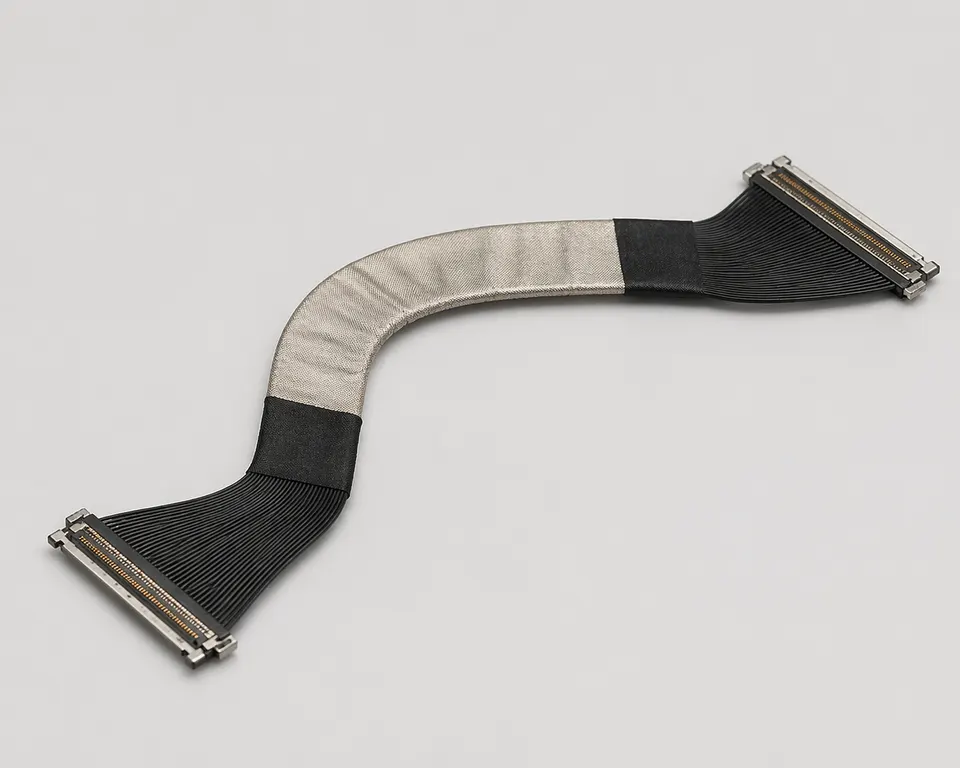
20455 Mating-Set Release Inputs
Use this page only when the board BOM identifies a CABLINE-VS 20455 receptacle. The exact suffix and position count still control which 20453 cable plug or applicable 20454 housing, 2574 shell, and accessory configuration can be reviewed.
| NO | Item | Typical Range or Meaning |
|---|---|---|
| 01 | Connector Path | I-PEX CABLINE-VS 0.5 mm-pitch system with a complete 20455 receptacle ordering code |
| 02 | Common Programs | Display platforms whose released board BOM and footprint specify a 20455 receptacle variant |
| 03 | Key Inputs | 20455 suffix and positions, manufacturer-listed mate, accessories, contact views, pin map, wire construction, and BOM revision |
| 04 | Structure Focus | Mating access, pull feature, cable exit, first bend, local fit, fixing, and connector-tail load |
| 05 | Revision Focus | Current I-PEX documents, customer footprint, old-part evidence, panel and board versions, and controlled release correspondence |
Compatibility Review Inputs
Use these items as first-round review inputs so the discussion does not rely on the page label alone.
Provide the complete 20455 suffix, position count, board footprint revision, and current I-PEX mating reference.
Provide cable-side component or assembly references, accessories, contact views, and the released end-to-end pin map.
Provide wire construction, finished dimensions, exit direction, first bend, fixing, pull or service access, and local clearance.
State panel, board, and legacy-part revision boundaries plus sample, pilot, and production quantities.
Define fit, continuity, operational-link, and any signal-integrity validation method, limits, fixture, and report format.
Customer Pain Points
I-PEX 20455 projects often look highly specific because the connector model is already known. In real RFQ and sample work, delays usually appear in the matching, layout, and revision details that decide whether the model-specific route is actually valid for the product.
| NO | Customer Pain Point | Typical Risk | What Needs Early Confirmation |
|---|---|---|---|
| 01 | Product design issues | The connector model is correct, but the mating relationship or local route still does not fit the enclosure | Mating interface, tail exit, route path, and installation space |
| 02 | Product quality issues | Connector-specific termination, route execution, or local fit drifts across batches | Structure definition, quality focus, and revision linkage |
| 03 | After-sales issues | It becomes hard to tell whether the issue came from the model, the route, the revision, or the installation condition | Drawing files, sample approval, batch labels, and shipment records |
| 04 | Complaint-handling issues | Revision boundaries are unclear, so issue tracing stays slow | Revision confirmation, batch correspondence, and inspection records |
Product Applications
I-PEX 20455 is not only a connector label. It usually appears in projects where the connector family has already been fixed and the next question becomes whether the matching and structure are truly release-ready. The five scenes below are the most common application contexts.
| NO | Application Scene | Scene Focus | Typical Concerns |
|---|---|---|---|
| 01 | Laptop display modules | The connector model is already frozen | Mating relationship, route space, revision freeze |
| 02 | Tablet and 2-in-1 terminals | The product context is clear but the space remains tight | Connector direction, local stacking, bend zones |
| 03 | Compact industrial displays | The model matters before the broader pin-count debate | Connector matching, route stability, fixing boundaries |
| 04 | Medical display modules | File correspondence and validation support matter more | Drawings, sample approval, batch traceability |
| 05 | Replacement programs | The old connector system still has to be checked against the current revision | Model confirmation, usable scope, release boundaries |
Control the Complete I-PEX 20455 Mating Set
20455 identifies a CABLINE-VS receptacle family, not a finished eDP assembly. The release package must name the position count, complete suffix, matching plug construction, accessories, pin map, and customer board footprint.
| NO | Boundary item | Required evidence | Release statement |
|---|---|---|---|
| 01 | Receptacle identity | Complete 20455 ordering code from the board BOM | Position count and suffix are frozen |
| 02 | Cable-side mate | Selected 20453 cable assembly, or the approved 20454 housing, 2574 shell, and applicable pull-bar configuration | Mate is confirmed by current I-PEX data |
| 03 | Housing and shell | Applicable 20454, 2574, and accessory references | Every loose component appears on the BOM |
| 04 | Contact orientation | Manufacturer drawing plus PCB pin-one datum | Harness view cannot be mirrored |
| 05 | Signal assignment | Platform schematic and panel connector table | Nets map without inferred substitutions |
| 06 | Cable selection | Wire type, size, length, and construction callout | Wire type and size satisfy the cited current, voltage-drop, and installed-bend calculations |
| 07 | Handling method | Assembly sequence and accessible pull feature | Operator instructions match the selected variant |
First-Party Engineering References
- I-PEX CABLINE-VS product documentation
Primary family data for 20455 receptacles, mating components, available positions, drawings, and manuals.
- I-PEX CABLINE-VS handling manual
Manufacturer handling guidance for CABLINE-VS only; the exact selected variant and latest controlled document still govern.
20455 Compatibility and Handling Risks
Most preventable failures come from shortening the ordering code, assuming a family-level mate, or applying force through the cable instead of the connector's intended handling feature.
| NO | Failure mode | Root cause to investigate | Control point |
|---|---|---|---|
| 01 | Variant mismatch | 20455 suffix omitted during sourcing | Purchase against the approved full code |
| 02 | Plug cannot engage | Wrong position count or mating component selected | Verify the two-part mating matrix |
| 03 | Receptacle damage | Angled insertion or cable-side loading | Train to the maker's handling method |
| 04 | Intermittent ground | Shell or drain treatment differs from the drawing | Inspect shield termination and ground continuity |
| 05 | False compatibility claim | Series data was generalized to an unlisted construction | Limit release notes to documented parts |
20455-specific First Article Evidence
First article approval should retain photographs and part-number evidence because an electrical pass alone cannot prove that the specified CABLINE-VS variant was installed.
| NO | Evidence check | Verification action | Approval record |
|---|---|---|---|
| 01 | Incoming identity | Inspect package label and component marking where provided | Lot linked to exact BOM code |
| 02 | Mating pair | Engage with the nominated board receptacle | Fully seated using the specified I-PEX handling method, with no housing, lock, or cable damage |
| 03 | Orientation | Compare datum marks and conductor breakout to drawing | Photograph captures pin-one relationship |
| 04 | Electrical mapping | Test all assigned contacts and isolation groups | Net-list report has no discrepancy |
| 05 | Handling trial | Perform approved assembly and removal sequence | No connector, latch, or cable damage |
| 06 | System operation | Run the platform's eDP functional test | Result tied to the tested panel revision |
Engineering Capability
The main engineering value in an I-PEX 20455 page is to make matching and local-structure judgement clearer before release. Cross-family engineering review, drawing control, and documentation practice are covered in the Related Capability Pages below.
Engineering Capability
Review tail-exit direction, route path, local stacking, and fixing details as one structure problem.
Confirm the receptacle and cable-side mating references, pin definition, and connector-orientation limits before the 20455 reference is treated as enough information.
Check whether old samples, replacement parts, and current device revisions still share the same usable I-PEX 20455-compatible boundary.
Quality and Verification Highlights
Focus on repeatable connector-specific execution and local route stability.
Watch connector tails, turn zones, and tape positions carefully in compact builds.
Keep model-to-structure correspondence visible across sample approval, inspection, and later batch release.
Evidence Chain
Sample Approval and Fit-Review Records
Use sample confirmation records and fit-review notes to show whether the approved sample actually matches the tail-exit direction, local path, and installation conditions being quoted.
Mating Interface and Pin-Map Basis
Keep customer BOM references, mating photos, pin definition, and connector orientation notes together so the compatible build is not judged by model name alone.
Replacement and Revision Scope
Record whether an old harness, replacement request, or shared platform revision stays inside the same approved connector and route boundary.
Files and Batch Support
I-PEX 20455 work has its own document layer around route and fitting boundaries. Cross-family file control, batch traceability, and certification practice are summarised in the Related Capability Pages.
Route and fitting-boundary records
Write the key route path, local fit limits, and installation-space constraints clearly enough that later structure differences can be traced back to the right layer of change.
Certifications / Records Visuals
IMAGES · 04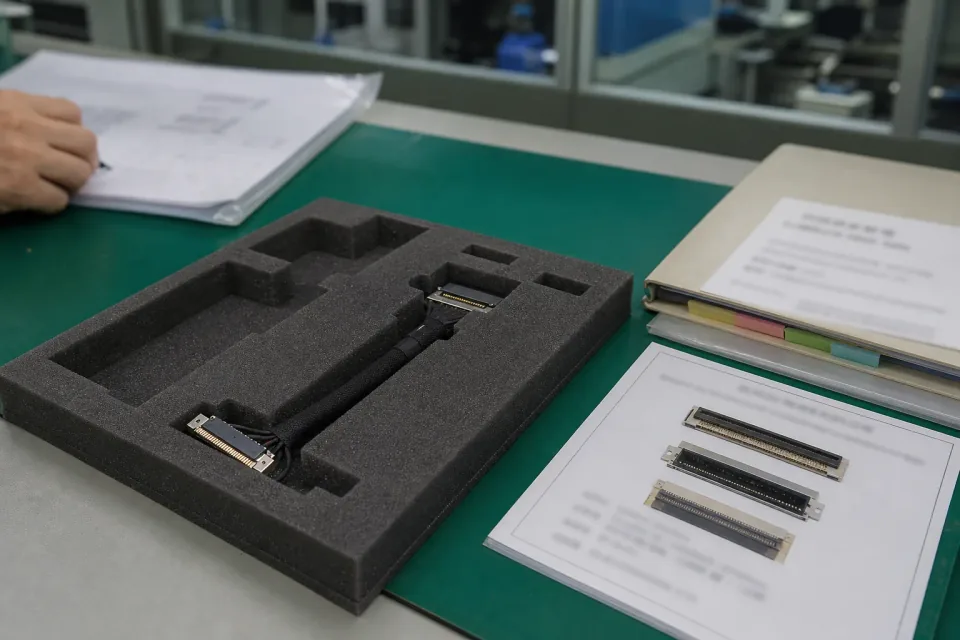
Sample-approval bench for a non-branded I-PEX 20455-compatible eDP harness with controlled drawing and sample tray
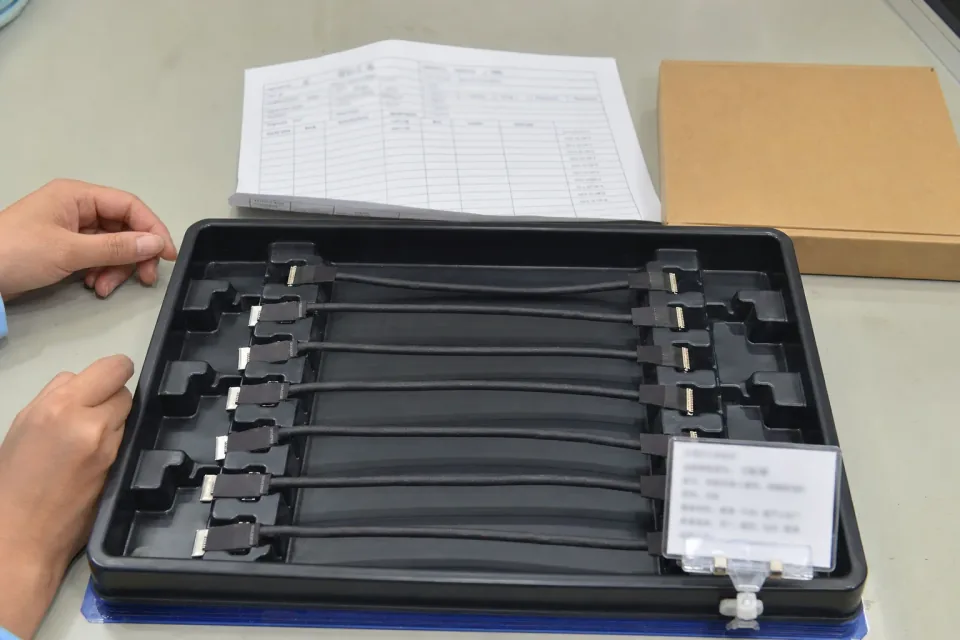
Batch lot tray and release-record staging for a non-branded I-PEX 20455-compatible eDP harness program, lot card and packaging sleeve visible
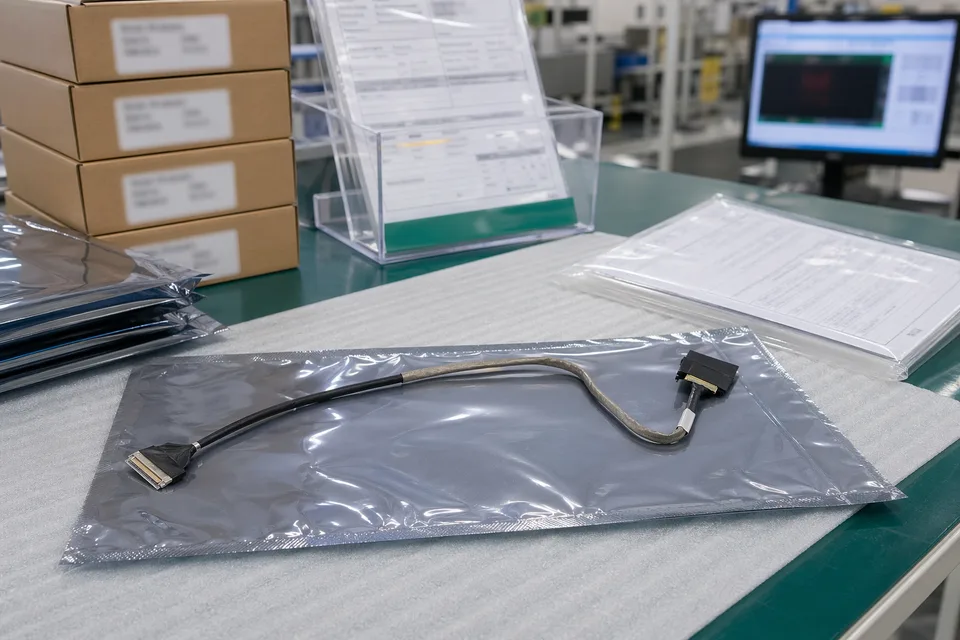
eDP revision traceability record with protected cable sample and controlled document sleeves
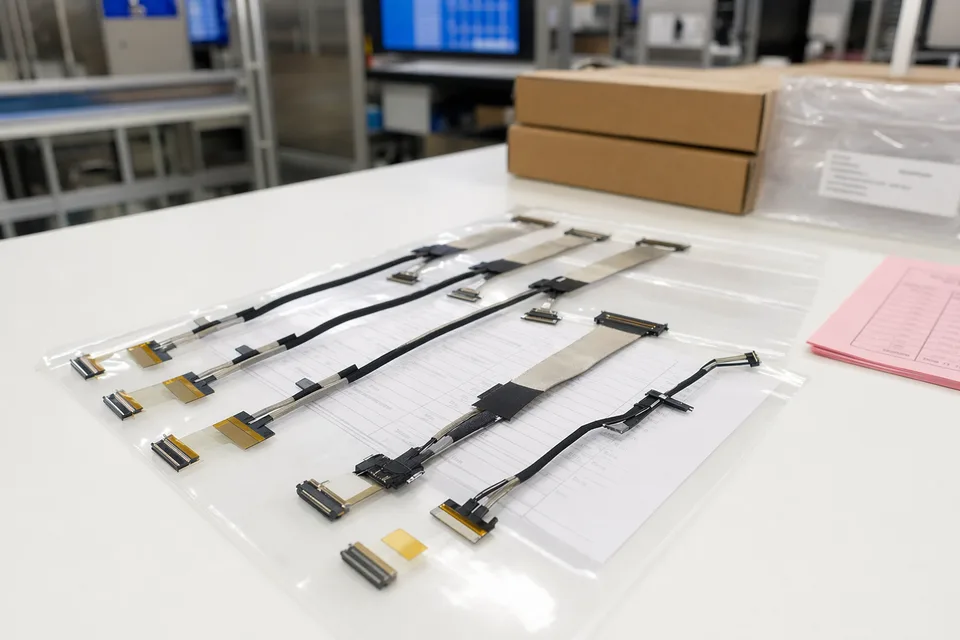
eDP batch release file scene with connector lot labels and display harness support context
FAQ
Can you build eDP cables compatible with the I-PEX 20455 interface?
Yes. Provide the complete mating reference, pin definition, length, tail exit, installation limits, and revision so compatibility can be reviewed beyond the receptacle family name.
What is the minimum information needed for an I-PEX 20455 quotation?
Provide the connector reference or clear photos, mating notes, pin definition, target length, installation conditions, project stage, and quantity.
If the project already knows it is I-PEX 20455, do we still need the 30-pin or 40-pin pages?
Use this page when mating fit and local structure lead the decision. Use the 30-pin or 40-pin page while pin count or the broader interface path is still being selected.
Can you simply copy an old I-PEX 20455 harness?
An old harness can start the review, but its mating part, pin definition, route, length split, local fit, and revision still require confirmation.
Can one I-PEX 20455 harness serve multiple display versions?
Only when pin definition, mating fit, local route, and every applicable display revision remain within one approved definition.
Trademark & Brand Notice
I-PEX® is a registered trademark of I-PEX Inc. I-PEX 20455 is a connector product series identifier owned by I-PEX Inc. The name identifies the mating interface direction specified in customer drawings, BOMs, samples, or interface requirements. The products described here are cable assemblies independently designed and manufactured by EDPcable, which is not affiliated with, authorized by, distributed by, or otherwise related to I-PEX Inc. When a customer drawing or BOM has already specified the I-PEX 20455 interface system, we provide custom cable assembly manufacturing built to be compatible with that interface; final delivery is governed by the drawings, samples, and engineering definitions confirmed by both parties.