Technical Reference · JAE-FI-X
JAE FI-X Compatible Interface
LVDS Harnesses for Exact JAE FI-X Mating Sets
Freeze the full wire-end and panel-end codes, suffixes, lock, map, route, and product revision
JAE publishes FI-X as a 1.0 mm-pitch LCD-interface family with multiple mating and lock variants. EDPcable uses that family reference only as a selection starting point: release still requires the complete cable-side and panel-side part numbers, position count, contact views, lock and suffix, pair grouping, shield and ground plan, route, and current platform revision.
Quick Links
QUICK ACCESSStart with the sections closest to the project structure, interface requirements, and validation scope.
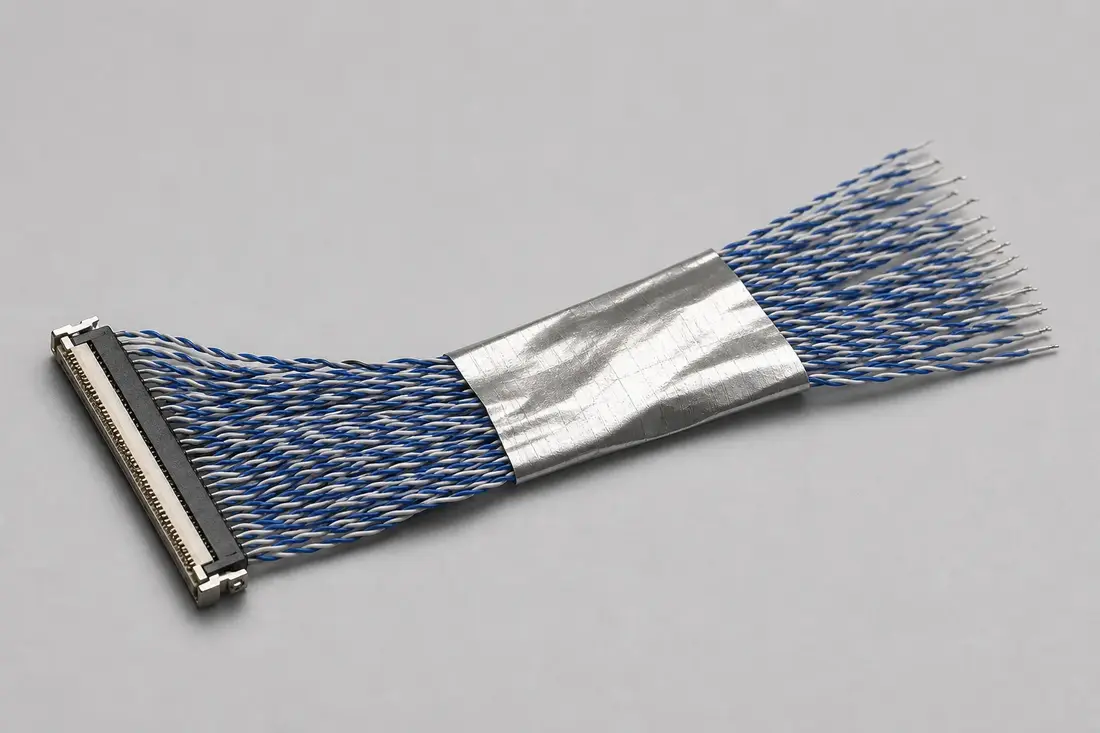
FI-X Mating-Set Release Inputs
Use this page when a drawing, BOM, or controlled legacy assembly identifies FI-X. The exact mating pair and suffix determine applicability; family pitch or appearance never authorizes interchangeability.
| NO | Review Item | Typical Range or Meaning |
|---|---|---|
| 01 | Typical Interface | Exact JAE FI-X wire-end and panel-end ordering codes specified by the customer BOM |
| 02 | Series Reference Parameters | JAE publishes FI-X as a 1.0 mm-pitch LCD-interface family; orientation, lock, positions, wire range, and ratings follow the exact part data |
| 03 | Typical Programs | Industrial monitors, medical displays, embedded panels, and TCON-to-panel links whose BOM specifies FI-X |
| 04 | Key Inputs | Full codes and suffixes, mating orientation, lock, positions, contact views, net map, pair grouping, wire, shield, and grounding |
| 05 | Boundary Risk | Lock, plating, wire range, and mating relationships can differ by suffix; a near-match or legacy part is not assumed interchangeable |
| 06 | Release Basis | Current JAE data, customer-confirmed drawing and BOM, controlled sample evidence, installed fit, and revision boundary |
Compatibility Review Inputs
Use these items as first-round review inputs so the discussion does not rely on the page label alone.
Provide complete wire-end and panel-end FI-X codes, suffixes, contact views, lock, and current JAE mating references.
Provide position count, released net map, pair grouping and polarity, power and controls, grounds, and reserved contacts.
Provide wire construction, shielding and grounding, dimensions, connector exits, route, bends, fixing, and clearance.
State sample, pilot, and production quantities, target dates, and all legacy or multi-model revision boundaries.
Define continuity, fit, image-operation, and any SI or EMC method, fixture, limits, and report scope.
Connector Compatibility Boundary
The most common rework cause in FI-X projects is not the cable itself but the mating relationship: a customer arrives with a legacy part or a photo of the current supplier's harness, the series name matches, but the lock type, suffix version, or panel-side interface does not. The conditions below should be walked through one by one before quotation and sampling.
| NO | Review Item | Why It Matters | Suggested Input |
|---|---|---|---|
| 01 | Full part number and suffix | Different suffixes within one series map to different locks, plating, or packaging forms | BOM, drawing, purchasing part number, or clear photos |
| 02 | Wire-end / panel-end mating | The wire-end plug must be reviewed against the actual panel-side interface, not just the series name | Panel-side connector model, panel datasheet, or a sample |
| 03 | Lock type | Locked and lock-free versions differ in assembly method and retention force, affecting installation and after-sales work | Lock form, assembly space, and removal requirements |
| 04 | Pin count and signal grouping | LVDS channel count drives twisted-pair grouping and wire order; a grouping error directly affects signal quality | Pin count, signal-definition table, panel timing reference |
| 05 | Twisted-pair and shielding structure | Twist pitch, shield form, and grounding affect EMI behaviour and routing space | Shielding requirement, system-level EMC conditions, route space |
| 06 | Version boundary | When several models share one series, define which versions the sample represents | Platform versions, replacement scope, legacy-part differences |
Customer Pain Points
Connector-led LVDS projects tend to run into the same pain points. The early confirmations below keep them from surfacing after sampling.
| NO | Customer Pain Point | Risk from the Connector-Model View | Confirm Early |
|---|---|---|---|
| 01 | Product design issues | The series name is locked but the lock or panel-side mating does not match, so the sample cannot be installed in the device | Full part number, panel-side interface, lock type |
| 02 | Product quality issues | Twisted-pair grouping or wire order drifts from the panel definition and display faults appear in volume | Signal-definition table, pair grouping, first-article confirmation |
| 03 | After-sales issues | Several models share one series with different suffixes, and field replacements do not match | Platform versions, batch labels, release records |
Connector-Compatibility Visuals
IMAGES · 01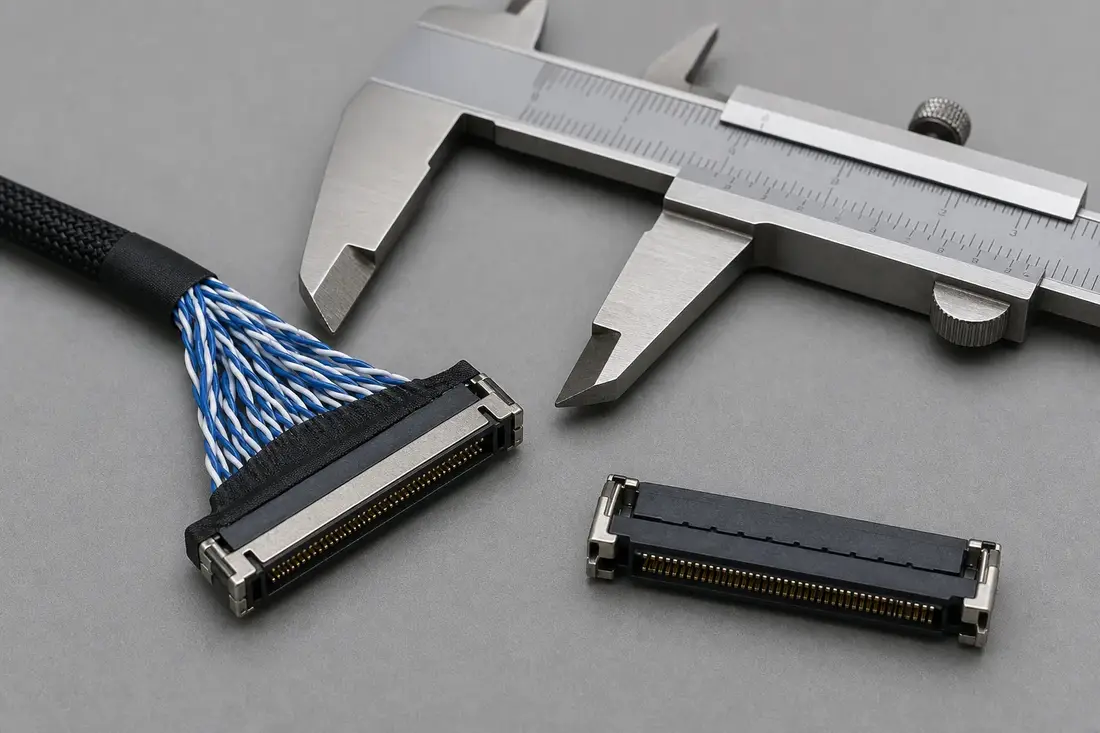
Non-branded FI-X-compatible connector review scene: fine-pitch LVDS board connector and twisted-pair cable end beside a separate mating-reference connector and a digital caliper
Set the FI-X Series and Part-number Boundary
JAE describes FI-X as a 1.0 mm-pitch LCD interface connector family, but family identity does not resolve lock style, termination type, contact count, or mating suffix. Treat every catalog value as specific to the complete JAE part numbers and documented mating configuration.
| NO | Selection boundary | Required project evidence | Released result |
|---|---|---|---|
| 01 | Board receptacle | Complete JAE code and current product drawing | Mounting type and orientation are fixed |
| 02 | Cable-side plug | Mating code supported by JAE documentation | Lock and termination style are named |
| 03 | Contacts | Approved contact code, wire range, and application tooling | Contact and wire pairing appears on BOM |
| 04 | Position population | Panel assignment and intended unpopulated contacts | Cavity-by-cavity loading table |
| 05 | Shell and grounding | Exact metal-shell variant and equipment ground plan | Bonding method is shown explicitly |
| 06 | Signal pairs | LVDS mapping, polarity, grouping, and electrical target | Twist and breakout definitions are controlled |
| 07 | Application limit | Device environment and JAE suitability review | Approval applies only to named equipment |
First-Party Engineering References
- JAE FI-X series product page
Primary FI-X family features, general specifications, variants, documents, and manufacturer application cautions.
- JAE connector tooling list
Manufacturer tooling reference for FI-X contacts; production uses the tool and setup approved for the complete contact code.
FI-X Mating, Lock, and Termination Risks
The review should distinguish documented JAE mating compatibility from visual similarity, then verify that crimping, locking, shell bonding, and service handling match that particular variant.
| NO | FI-X failure mode | Cause to investigate | Manufacturing control |
|---|---|---|---|
| 01 | Mating pair conflict | Plug and receptacle were chosen by series name | Approve complete codes against maker documents |
| 02 | Lock does not engage | Friction and mechanical-lock variants were confused | Inspect selected lock and counterpart |
| 03 | Crimp instability | The contact, wire, or applicator combination is outside the manufacturer data or validated process window | Use validated application-tool parameters |
| 04 | Shell ground absent | Variant or assembly omits intended conductive path | Check shell construction and bond continuity |
| 05 | Part used beyond review | Catalog characteristics were extended to another suffix | State part-specific limits in release notes |
FI-X First Article and Production Controls
Approval should combine JAE-document conformance with assembly evidence and target-device testing; no single layer by itself qualifies the complete LVDS assembly for release.
| NO | Control stage | Verification method | Acceptance evidence |
|---|---|---|---|
| 01 | Incoming parts | Match the full ordering code, package label, marking, lock style, and drawing-defined geometry to the approved BOM | Lot trace includes complete JAE codes |
| 02 | Termination setup | Validate crimp or solder process for selected construction | Setup record and sample inspection pass |
| 03 | Cavity loading | Compare loaded plug to contact-position drawing | Position map has no omission or reversal |
| 04 | Mating operation | Engage production-intent receptacle using defined method | Full lock without housing damage |
| 05 | Electrical inspection | Test nets, isolation, and specified ground bonds | Results meet released cable print |
| 06 | Device confirmation | Operate named board and panel through required modes | Report identifies exact mating set and platform |
Engineering Capability
Engineering review fixes mating, signal grouping, route, and version before release.
Engineering Capability
Confirm both mating part numbers, lock, suffix, orientation, and installation clearance rather than relying on the FI-X series name.
Release pin count, wire order, LVDS pair grouping, shield and ground paths, and panel timing reference together.
For legacy or multi-model programs, identify which suffix and platform revisions each approved sample represents.
Quality and Verification Highlights
First-article checks compare wire order, pair grouping, termination, and shielding with the panel definition.
Inspection and batch labels trace to the same drawing revision and complete part reference.
Customer installation, display, and EMC validation determine release; the brand series alone proves no compatibility.
Evidence Chain
Mating and suffix confirmation records
Fix the full connector reference, panel-side mating, and current version boundary as the sample-review basis.
Wire-order and grouping review records
Record signal definitions, twisted-pair grouping, and the shield-grounding plan so samples stay aligned with the panel definition.
Sample and batch tracing
Keep sample confirmation, shipment labels, and batch files pointed at the same released version.
Files, Records, and Brand Boundary
Credibility in an FI-X-compatible project comes from traceable drawings, wire-order definitions, and version records — not from unverified brand-authorization wording.
Connector reference records
The customer-specified series, suffix, and mating relationship are recorded for later repeat orders.
First-article and inspection records
First-article confirmation plus appearance, continuity, and wire-order checks correspond to the current version.
Batch labels and shipment files
Batch labels, carton marks, packing details, and agreed accompanying documents are supported.
Brand boundary note
JAE and FI-X identify the customer-specified interface family only; EDPcable does not claim to be JAE's agent, authorized assembler, or official partner.
Certifications / Records Visuals
IMAGES · 04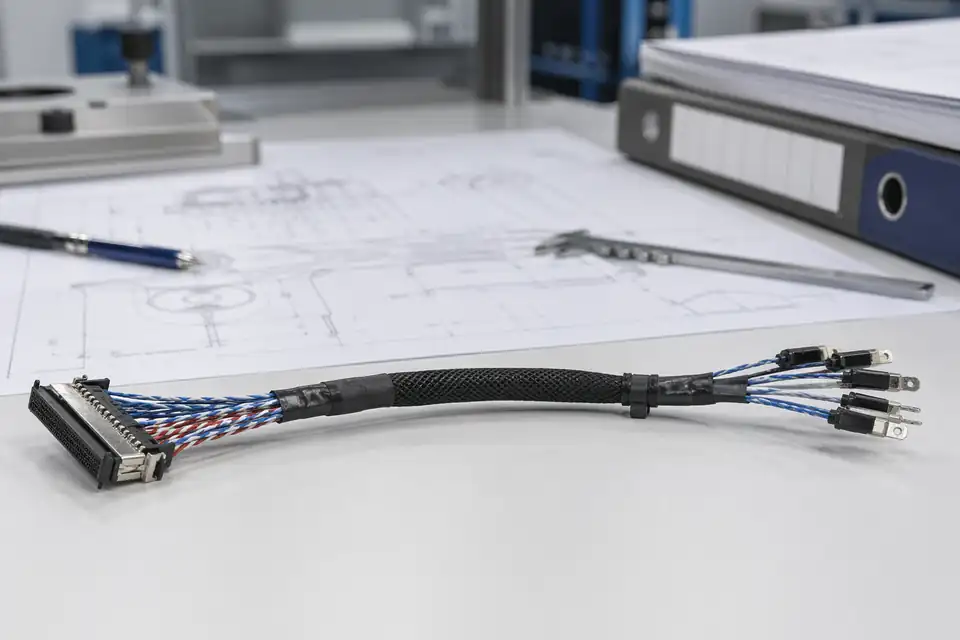
LVDS cable assembly with controlled records and identification labels
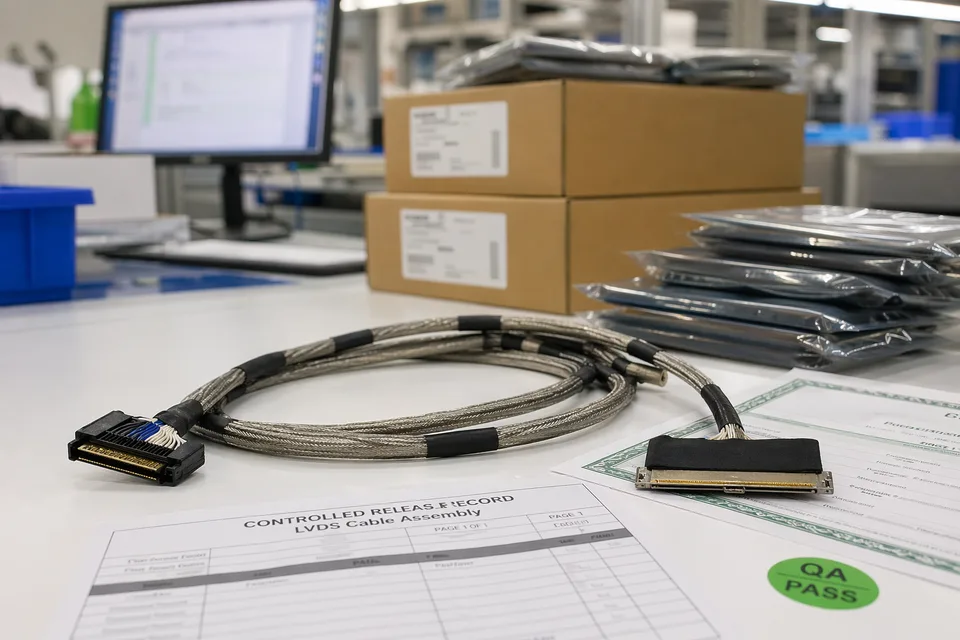
LVDS controlled release records with sample cable foreground and document sleeves
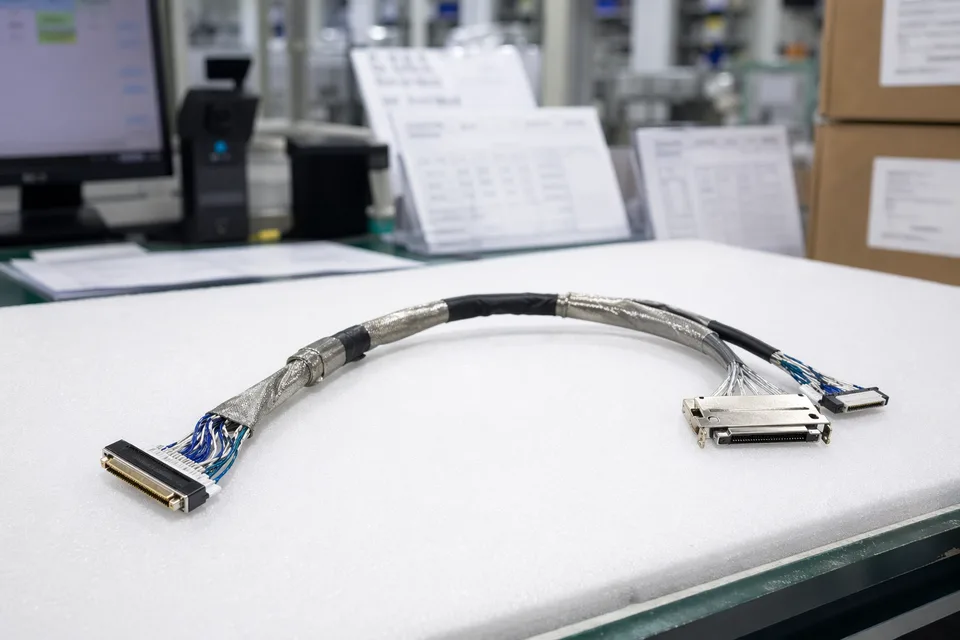
LVDS batch traceability archive with connector lot cards and harness sample visible
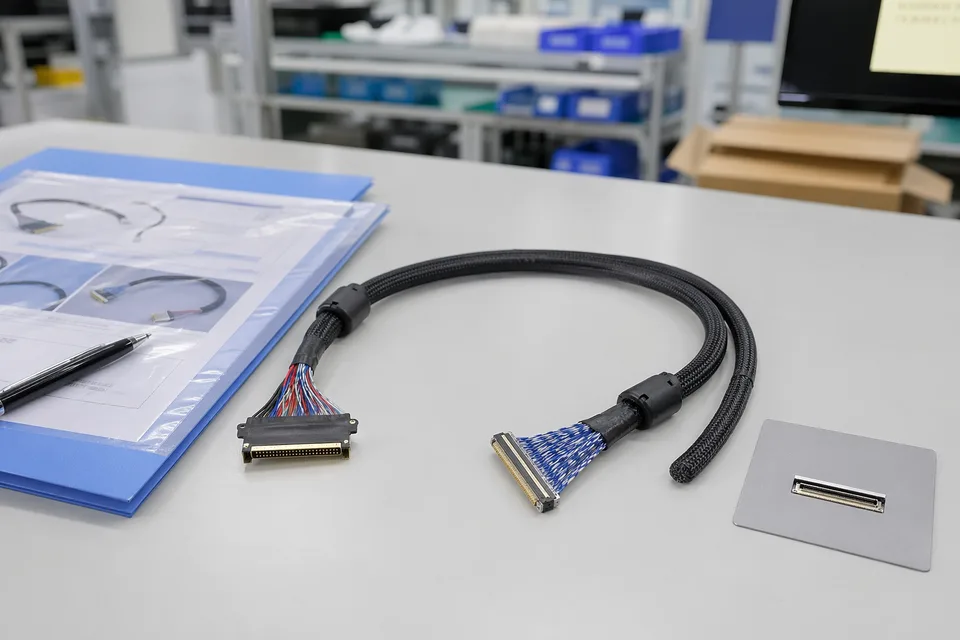
LVDS sample approval folder beside shielded cable assembly and panel connector mockup
FAQ
Can you build LVDS cable assemblies compatible with JAE FI-X connectors?
Yes, after both mating part numbers, lock and suffix, pin map, route, and version are confirmed. Compatible manufacturing does not imply JAE authorization.
Can you quote from a description like "FI-X 30 pin" alone?
It can start review, but quotation requires the full suffix, panel-side interface, pair grouping, length, shielding, grounding, and quantity because locks and mating can differ.
How is this page different from the LVDS 20-50 Pin page?
Use this page when FI-X part numbers and mating lead the decision. Use the 20-50 Pin page while pin count and channel structure are still being selected.
Can you copy a legacy part?
A legacy part can start review, but its suffix, lock, wire order, mating interface, and current panel revision must be re-confirmed.
Can you supply original-maker connectors or authorization files?
No JAE authorization or agency claim is made. Original-part requirements must be stated in the BOM; delivery follows the mutually confirmed materials and drawings.
Trademark and Brand Notice
JAE is a trademark of Japan Aviation Electronics Industry, Ltd., and FI-X is a product-series designation of its connectors. These names are used only to identify the interface-mating direction of the current project. The products on this page are compatible cable assemblies independently designed and manufactured by EDPcable, with no agency, authorization, distribution, or cooperation relationship with Japan Aviation Electronics Industry, Ltd. When a customer drawing or BOM has locked the JAE FI-X connector system, we provide custom harness manufacturing that mates with that interface; final delivery follows the mutually confirmed drawings, samples, and engineering definitions.