Micro-Coax or FFC: Start with the Complete Connection
Choose the cable and both connector ends together. FFC is a candidate when its flat route, contact arrangement and documented channel performance meet the design. Micro-coax is a candidate when its individual outer conductors and bundle routing meet the same requirements. Neither construction alone establishes speed, EMC performance, current capacity or hinge life. Compare exact part numbers under the same installed conditions before choosing either or a hybrid.
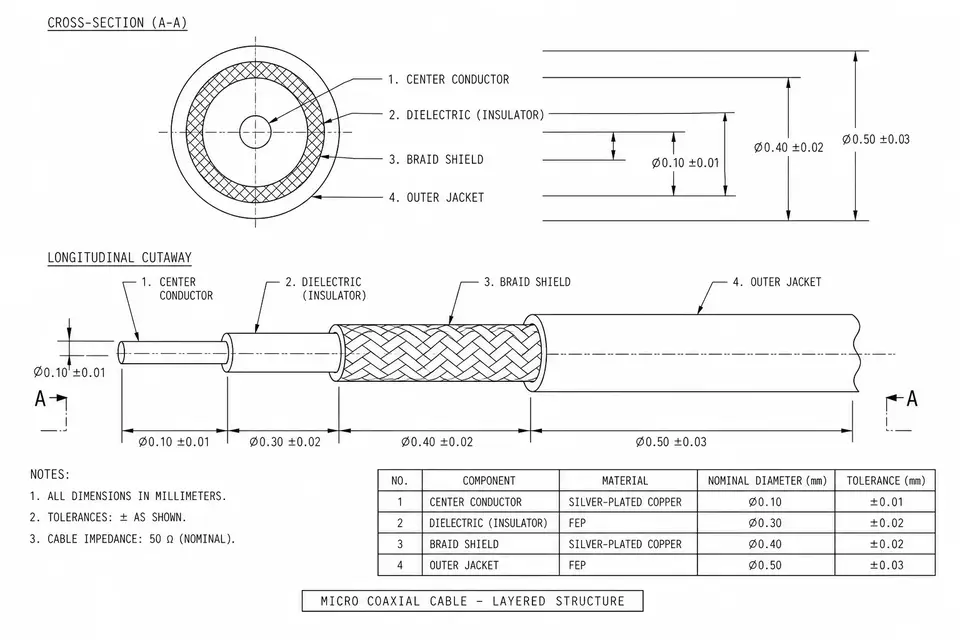
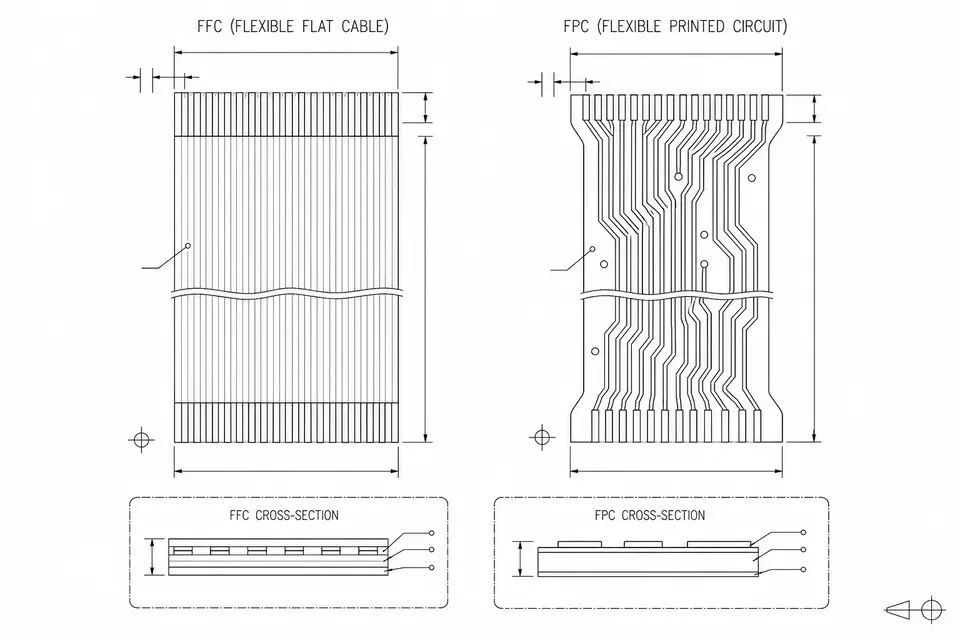
FFC places conductors in a flat parallel construction; micro-coax surrounds each center conductor with dielectric and an outer conductor. A cable's shield must be considered together with the transition into the connector and board. Start the commercial specification at Micro-Coaxial Cable Assemblies or FFC / FPC Cable Assemblies.
Shielding and High Speed: Check the Actual Product
FFC does not universally mean unshielded or low speed. Molex's Premo-Flex portfolio includes shielded and high-speed flat-cable options. This establishes that such options exist; it does not qualify an arbitrary FFC or our finished assembly.
For micro-coax, identify the outer-conductor termination, ground bar, connector shell and board return path. An individually shielded cable cannot establish the EMC performance of an undocumented connector transition. The I-PEX CABLINE-VS specification identifies applicable cable constructions and connector test conditions. Those component conditions must not be represented as a qualification of the customer's complete harness.
Ask for the selected cable/connector channel data at the required length and signaling conditions. Define impedance, loss, crosstalk and system compliance limits from the actual interface and endpoints. Do not assign a universal Gbps ceiling to either construction. See impedance control and cable shielding for the separate measurement and grounding questions.
Six Comparisons That Belong in the Drawing Review
| Decision input | FFC evidence to obtain | Micro-coax evidence to obtain |
|---|---|---|
| Channel | Exact cable, ground assignment and both connector transitions | Exact coax lines, pair assignment and both connector transitions |
| Shield and return | Shield option, contact/ground arrangement and board connection | Outer-conductor termination, ground bar, shell and board connection |
| Installed space | Flat width, thickness, stiffener, insertion access and fold keep-outs | Bundle envelope, fan-out, connector access and strain-relief volume |
| Motion | Cable-specific bend/twist conditions and installed motion test | Cable/bundle-specific bend/twist conditions and installed motion test |
| Power/control | Conductor/contact ratings, loaded contacts and thermal conditions | Selected conductors/contact ratings, loaded contacts and thermal conditions |
| Supply and process | Matched contacts, retention, tooling, inspection and qualified quote | Cable preparation, termination, retention, inspection and qualified quote |
A flat profile may help in a stacked enclosure; a bundle may suit a curved route. Check the actual envelope throughout travel. Neither a small connector pitch nor a round cross-section is proof of a fit or a fatigue-life result. Folded routing and 0.25mm pitch micro-coax address different drawing inputs.
Worked Selection Example: A Moving Display Hinge
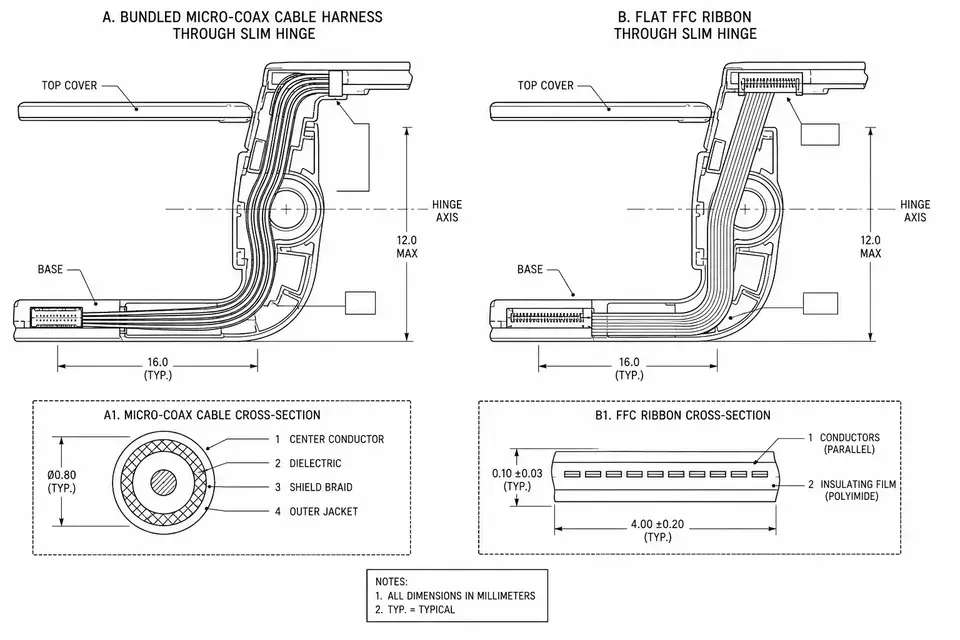
Consider an illustrative 180 mm board-to-display link with high-speed pairs, control lines and a moving hinge. This is a planning example, not an EDPcable test report. Keep the endpoints, required channel limits and travel profile identical when comparing alternatives.
First, map every signal, return and power contact at both ends. An FFC and a micro-coax assembly with the same contact count are not interchangeable unless the complete mapping and mating interfaces agree. Next, draw the cable at both travel extremes, including connector exits, clamps and adjacent surfaces. Identify bending, twisting, sliding and connector loading separately. A supplier's flex-cycle headline cannot replace the installed motion conditions.
Then compare the exact two assemblies before and after the agreed motion exposure. Define the sample plan and acceptance limits before testing; a static continuity pass cannot establish a high-speed channel margin or hinge lifetime. If the shield connection is undefined, hold the design for grounding review. If the motion evidence is absent, hold the lifetime claim. Do not cure either missing input simply by changing the cable family. The display-hinge application helps frame the routing discussion.
Verification and Release Checklist
The following is a proposed project checklist. The design owner must set the numerical limits, sample count, environment and test sequence for the actual device.
| Check | Evidence to retain | Hold the release when |
|---|---|---|
| Interface and pin map | Both mating part numbers, drawing views and a full net/return map | Orientation, contact side or a return assignment is unresolved |
| Grounding | Drawing of shield/outer-conductor, connector and board connections | A transition relies on an assumed shield connection |
| Channel | Agreed measurement boundaries, fixtures and interface-specific results | Results use a different length, grounding or transition |
| Installed motion | Travel, bend/twist geometry, clamps, environment and before/after results | Cycle claims lack matching installed conditions |
| Electrical and thermal | Wire map, selected power contacts, load and temperature evidence | A contact rating is copied without its applicable conditions |
| Manufacturing and supply | Controlled BOM, inspection points, retention checks and comparable quote | An alternate changes construction or mating without review |
Use build-to-print process controls for controlled preparation and inspection, electrical testing for the agreed wire-map scope, and RF and impedance testing for a separately defined channel measurement plan.
When a Hybrid Makes Sense
Group nets by their actual electrical, return-path and mechanical needs. A hybrid can be useful when each segment has a documented reason, but it also adds transitions, assembly steps and validation work. Compare it with single-medium alternatives against the same checklist. Power, touch and control lines still require current, voltage-drop, noise and thermal checks; they are not automatically suitable for an unspecified FFC.