What makes a cable micro-coaxial?
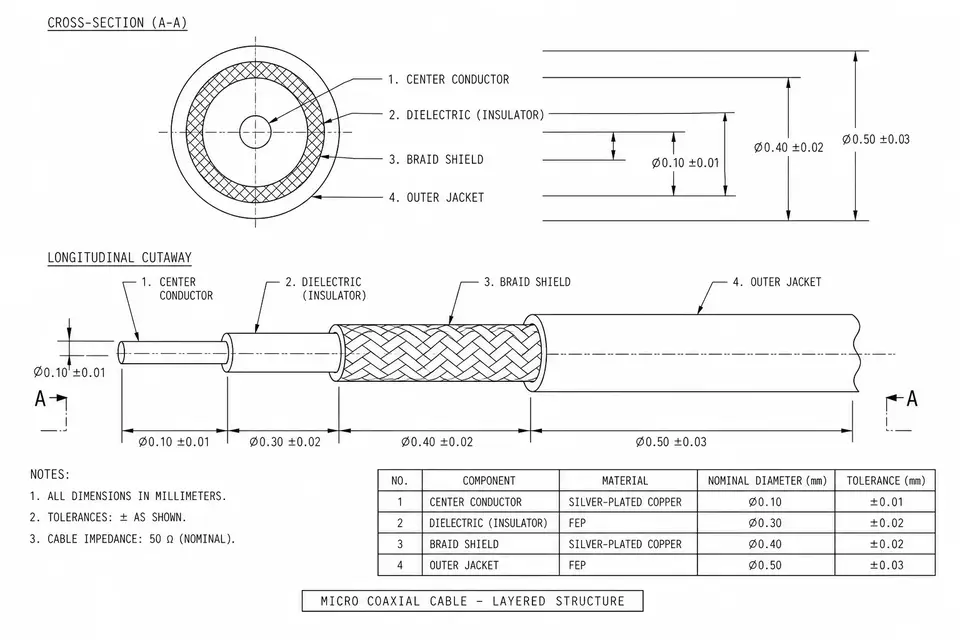
A micro-coaxial cable is a small coaxial construction: a center conductor, surrounding dielectric, outer conductor and protective jacket. It is used for compact signal interconnects. The cable structure does not identify a connector, protocol or qualified assembly. There is no single AWG, pitch, speed or bend-life rating that describes every micro-coax product.
I-PEX explains the outer conductor's shielding role and the use of micro-coax in digital interconnects. Shielding in the cable still needs a defined connection through its terminations; a shielded wire alone does not prove system EMC performance.
| Layer | Purpose | What to identify |
|---|---|---|
| Center conductor | Carries the signal | Conductor construction, material and gauge |
| Dielectric | Separates inner and outer conductors | Material and controlled geometry |
| Outer conductor | Provides the surrounding conductive screen | Construction and termination path |
| Jacket | Protects the cable surface | Finished diameter and application conditions |
AWG, outer diameter and connector pitch are different
AWG identifies conductor size, not the complete cable diameter. Connector pitch measures adjacent contact centers, not wire diameter or guaranteed cable clearance. Read the exact cable drawing and both connector application specifications together. A smaller cable is not automatically an approved replacement.
For a concrete component example, Fujikura's cable table lists its AWG42 example with a 0.075 mm center-conductor diameter and a 0.29 mm jacket diameter. These are different dimensions of that listed construction; they do not establish a universal AWG42 diameter or compatibility with a particular connector.
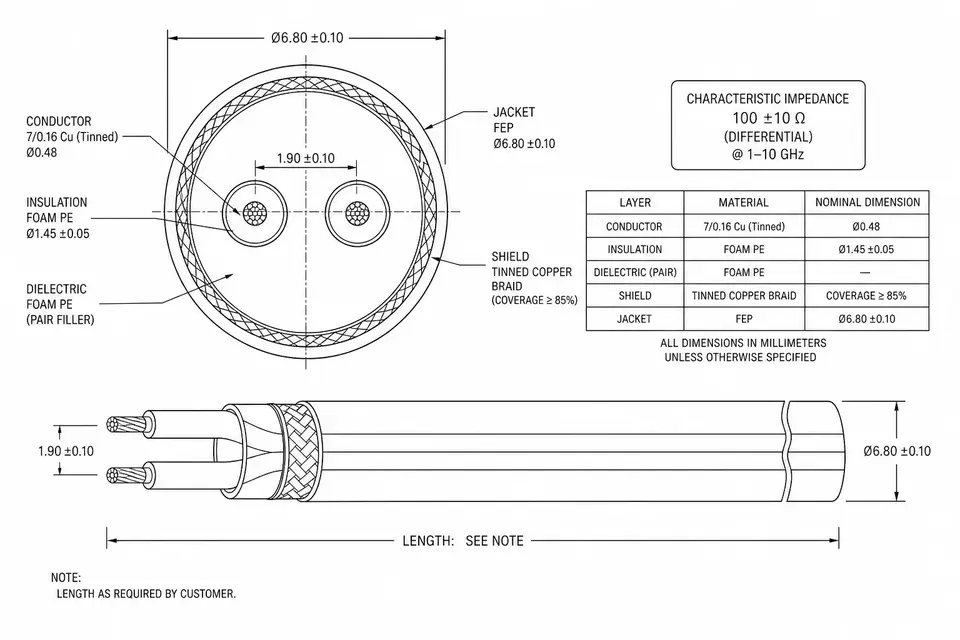
Keep cable impedance and pair impedance in separate RFQ fields. A single-ended value is referenced to the cable's outer conductor; a differential value describes the two signal conductors as a pair. Do not treat a 50 Ω cable entry as proof of a 100 Ω assembled pair. Specify the interface target, tolerance, reference planes and measurement arrangement. See impedance verification planning.
A routing-width example that AWG cannot answer
Suppose an early drawing places eight cables in one flat row, each at an assumed maximum diameter of 0.30 mm, with seven assumed gaps of 0.05 mm. The geometric row width is 8 × 0.30 + 7 × 0.05 = 2.75 mm. If the maximum diameter changes to 0.32 mm, the same model becomes 2.91 mm, an increase of 0.16 mm.
These are hypothetical inputs, not a manufacturer limit, bundle-diameter formula or clearance approval. Tape, sleeves, fan-out, manufacturing tolerances and the moving envelope require their own allowances. A row that fits while straight can still fail in a hinge. Confirm the actual route and motion with a representative assembly rather than deriving bend radius or cycle life from AWG.
Six checks before choosing or replacing an assembly
I-PEX's selection guide treats signal requirements, connector dimensions, cable choice and mating constraints as related decisions. Use the following evidence checklist for the complete assembly.
| Decision | Evidence to request | Hold the decision when |
|---|---|---|
| Connector fit | Full plug/receptacle numbers, revisions, pin map and mating direction | Only brand, pin count or pitch is known |
| Cable fit | Exact construction, finished maximum diameter and approved termination | Only AWG is supplied |
| Signal path | Interface, length, impedance definition, loss/skew requirements and test planes | A component headline is offered as assembly proof |
| Shield path | Shield termination, connector/board ground path and EMC test plan | Continuity alone is claimed to prove shielding |
| Installed motion | Routing, strain relief, bend/twist conditions and qualification plan | A generic bend-life claim replaces project conditions |
| Release evidence | Drawing revision, inspection/test records and change approval | A substitute changes geometry or materials without review |
Continuity detects opens and mapping errors under the defined test; it does not establish impedance, high-frequency loss or flex life. Keep these checks separate in the electrical test plan.
Where micro-coax fits and what to send in an RFQ
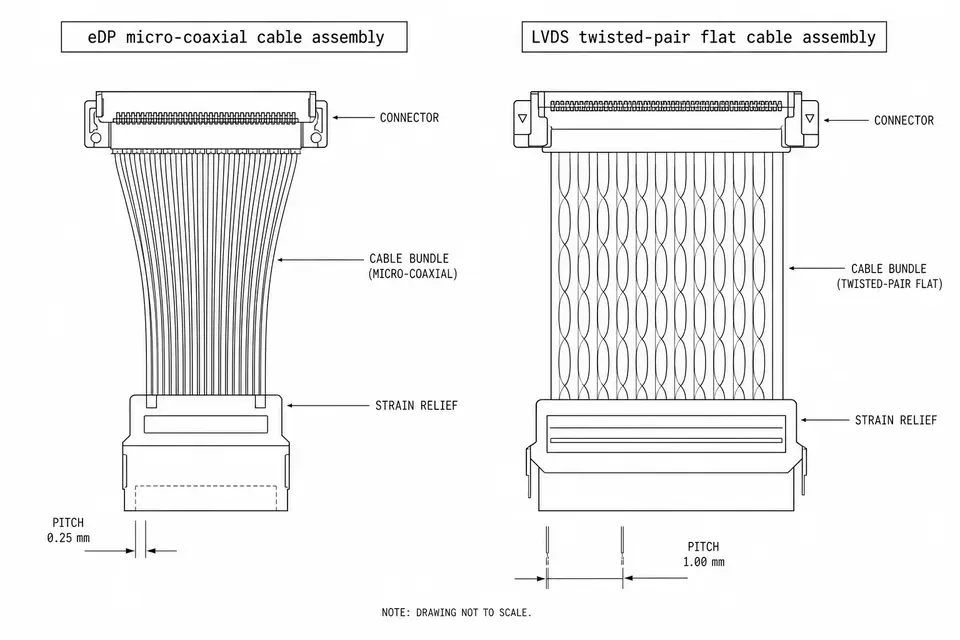
Micro-coax describes construction; eDP and LVDS describe signaling contexts. FFC is a different cable construction. An FFC replacement requires review of mating geometry, pin map, shielding, signal path and motion, even at low data rates. Compare those decisions in micro-coax versus FFC.
Send the exact connector pair, pin map, cable drawing, length/tolerance, installed route, interface requirements, shield connections, qualification conditions and sample/production quantities. Include photographs as identification aids, not substitutes for drawings. Start with micro-coaxial assemblies; use the fine-pitch route or I-PEX route after confirming the actual connector. No component example here certifies a finished assembly or medical device.