What is the difference between FFC and FPC?
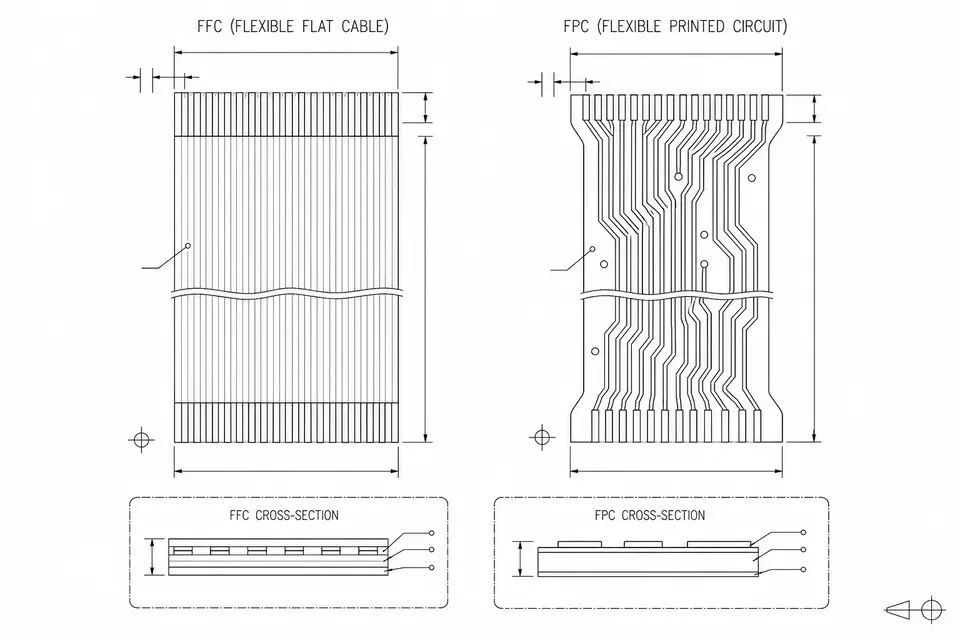
FFC means flexible flat cable. In a typical construction, parallel flat conductors are laminated between insulating films. FPC means flexible printed circuit: a circuit pattern is formed on a flexible substrate and may include shaped outlines, pads, stiffeners, openings or multiple conductive layers. The distinction is the construction and routing function, rather than how similar the finished pieces look.
A simple connection can be implemented in either form if its complete requirements are met. Start with the electrical map and installed geometry, then choose a construction that can deliver them. An FPC is not automatically a more durable FFC, and an FFC is not automatically suitable for every display connector.
Compare the design inputs, not just the names
| Design question | Typical FFC approach | Typical FPC approach |
|---|---|---|
| Conductor layout | Regular parallel conductors | A designed trace pattern |
| Shape and local features | Cable length, exposed ends and defined folds | Outline, pads, openings and local support zones |
| Circuit routing | Verify the conductor-to-contact map | Verify the netlist and trace routing |
| Connection ends | Tail dimensions matched to exact receptacles | Connector tails, pads or other specified terminations |
| Drawing package | Cable drawing, end views and material specification | Circuit data, outline, stack-up and assembly drawing |
| Production decision | Assess available construction, tooling and quantity | Assess circuit fabrication, assembly and quantity |
| Motion and reliability | Qualify the specified cable and installed route | Qualify the specified circuit and installed route |
Cost and lead time depend on the actual materials, processes, quantities and design work. Likewise, neither name establishes current capacity, transmission performance, environmental suitability or a bending-cycle rating. Compare quotations against the same released requirements.
Can FFC and FPC use the same connector?
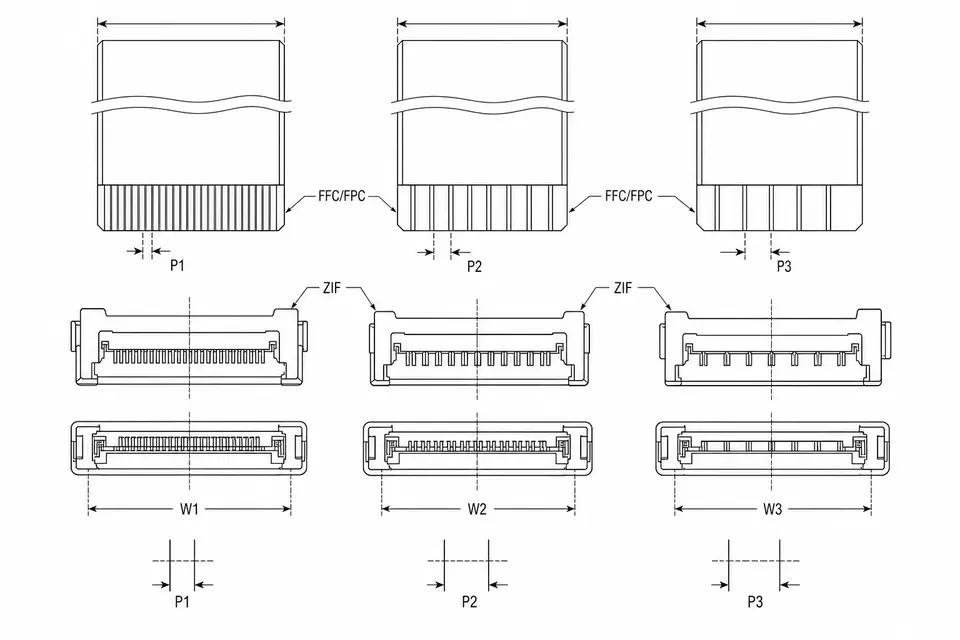
Some connector families accept both, but the exact mating-end specification controls. A listing headed FFC/FPC does not approve every cable or circuit with the same pitch. The Molex FFC/FPC connector range includes different actuator and locking arrangements; select the actual part and its application drawing.
Before substituting one construction for another, close these checks at both ends:
| Check | Evidence | Stop if |
|---|---|---|
| Pitch and contact count | Connector and mating-tail drawings | Contact locations or populated positions differ |
| Exposed contact side | End views with stated viewing direction | Conductive surface faces away from connector contacts |
| Insertion-end thickness | Tail section including the stiffener | Thickness or tolerance does not match |
| Tail width and exposed length | Specified mating-end dimensions | Contact area or insertion geometry differs |
| Locking features | Ears, notches and lock requirements | Required lock feature is missing or differs |
| Pin mapping | Net-to-contact map at both ends | Supply, signal or return mapping differs |
| Installed routing | Length datums, bend zones and assembly clearance | Fit needs twisting, force or load |
The Hirose FH12 family documents top-contact, bottom-contact and vertical variants. Its product guidelines specify different insertion orientations. This is a concrete reason to check the connector variant rather than treating an exposed copper side or a stiffener photograph as sufficient identification. Follow the applicable assembly instructions; do not force an actuator closed to compensate for a mismatched or partly inserted tail.
Two examples that change the choice
A straight display-to-board connection. Both endpoints are defined, the net map is simple and the route is fixed. An available FFC construction may meet the need after its tail geometry and end orientation are checked. If a proposed replacement has the same pitch and contact count but its exposed contacts face the wrong side, the replacement remains unsuitable. Reversing it is only acceptable if the complete map and installed geometry also permit that change.
A circuit routed around a housing feature. The interconnect needs a shaped outline, an intermediate pad and a different trace arrangement between its ends. Review an FPC with explicit circuit and mechanical data. A parallel-conductor cable cannot be assumed to reproduce that circuit function merely because its end looks similar. If the design then transitions to discrete wires, define the FPC-to-wire hybrid interface, support and termination requirements as part of the same drawing package.
These are illustrative decisions, not test reports for a particular product. For either construction, distinguish a bend made during installation from repeated movement in service. Specify the route, restraints and motion conditions, then qualify the selected construction; no universal bend radius or service life follows from FFC or FPC alone.
A selection sequence for the drawing review
- Record each endpoint and its full connector number, including the variant and relevant drawing revision.
- Establish the electrical map. Identify every signal, supply, return and intentionally unused position.
- Decide whether regular conductors can implement the map or whether custom circuit routing and local features are required.
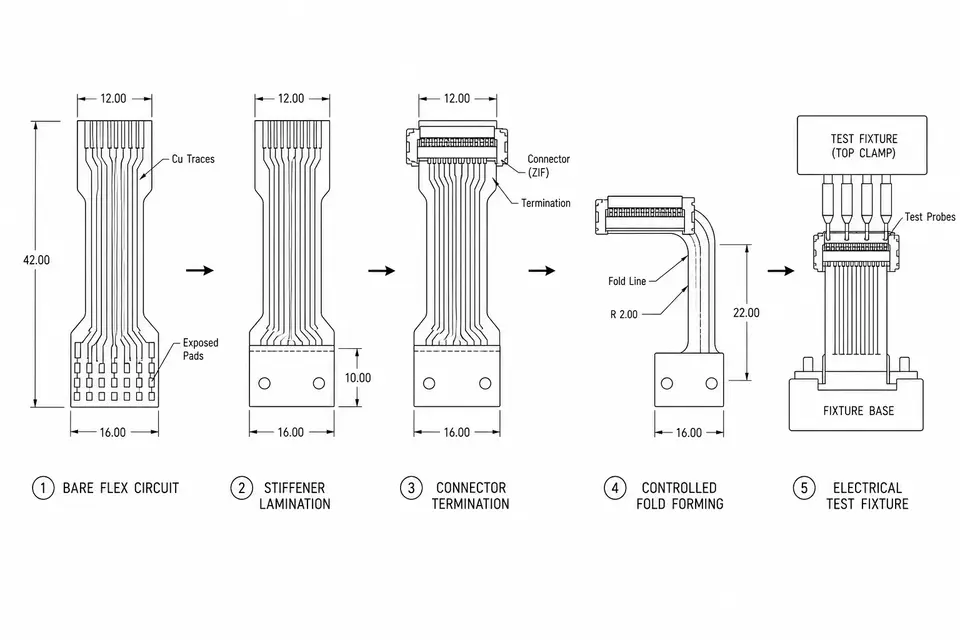
- Check both insertion ends against the connector drawings. Include contact side, thickness, stiffener, dimensions and locking features.
- Review the installed shape and assembly sequence. Mark fixed bends, moving zones, supports and clearance at the first bend after each connector.
- Close the material, process, quantity and verification requirements before comparing supplier proposals.
Use FFC/FPC cable assemblies for the commercial drawing review and fine-pitch interconnects for the relevant specification path. The separate FFC pitch guide develops pitch selection; FPC assembly covers the fabrication and assembly sequence.
What to send for RFQ and sample acceptance
Send a dimensioned cable or circuit drawing, mating-part documents, end views, the point-to-point map, materials, stiffeners, installed route, quantity and project stage. For an FPC, include the circuit data, outline, stack-up and any populated or bonded regions. For a hybrid, include both the circuit and wire-end requirements. A photograph helps identify a part, but cannot establish its thickness tolerance, electrical map or acceptance limits.
Keep release checks separate from application qualification. Electrical test planning can define opens, shorts and mapping checks. Confirm dimensions and mating against the actual parts, then evaluate any specified motion, environment and channel performance under the approved test plan. A continuity pass does not prove flex life or complete system performance.