1. What Impedance Control Actually Controls
Impedance control defines and maintains the transmission-line geometry and electrical target required by the interface. The finished assembly also needs an agreed measurement mode, test boundary and acceptance method. Conductor spacing, dielectric structure and transitions affect the result; an ordinary continuity test cannot establish high-speed performance.
The familiar phrasings — 50 ohm single-ended, 75 ohm video coax, 100 ohm differential — are just different ways of stating that target. The number shouldn't be guessed; it should come from the interface standard, the project drawing, or the main-board or module spec.
2. Why a Cable Passes Continuity and the System Still Fails
This is the least intuitive part of high-speed cabling. Continuity, insulation, and pin-mapping checks answer "is it wired right, is it connected" — they can all pass and still say nothing about whether the high-speed signal stays stable along that path. A cable can be perfectly continuous yet, because of an impedance discontinuity, inconsistent termination, or poor shield handling, show up at the system as flicker, image noise, link-training failure, or thin EMI margin.
Put differently, ordinary electrical testing is a necessary baseline, not a verdict on high-speed behavior. To see the high-speed side, you need TDR to watch how impedance rises and dips along the length, and where needed VNA to look at loss and reflection in the frequency domain.
3. What Pulls a High-Speed Cable's Impedance Off Target
There are several factors, but they all trace back to one thing — the structure changed:
| Factor | How it shifts impedance |
|---|---|
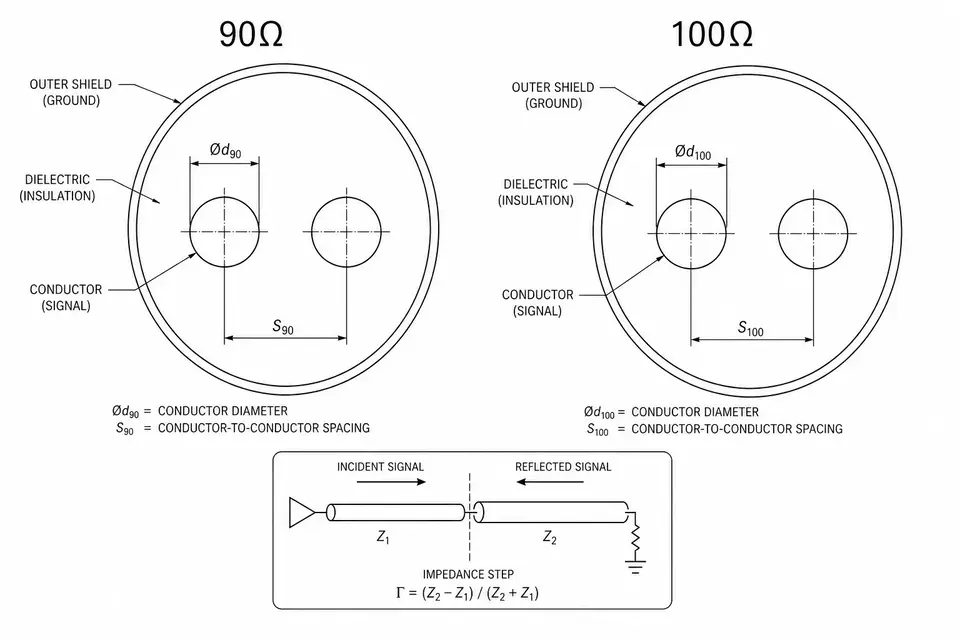
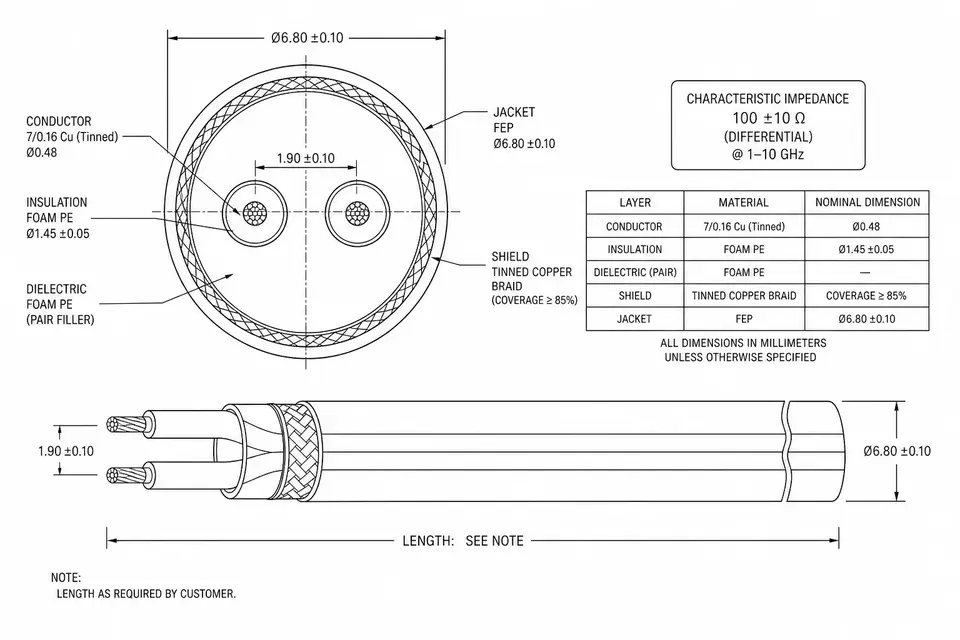
| Conductor size, pair spacing | Changes field distribution; differential impedance is especially sensitive |
| Dielectric material | A different dielectric constant changes propagation |
| Shielding structure | Alters the return path and noise environment |
| Termination window | Stripping, soldering, and crimping are where discontinuities appear |
| Connector | The mating area is a common impedance step |
| Bend, fixation, length | Over-compression changes local geometry; length affects loss and margin |
So "100 ohm cable" on a drawing usually isn't enough — cable, connector, termination, shielding, and test conditions are best stated together.
4. What It Looks Like in eDP, LVDS, and Micro-Coax
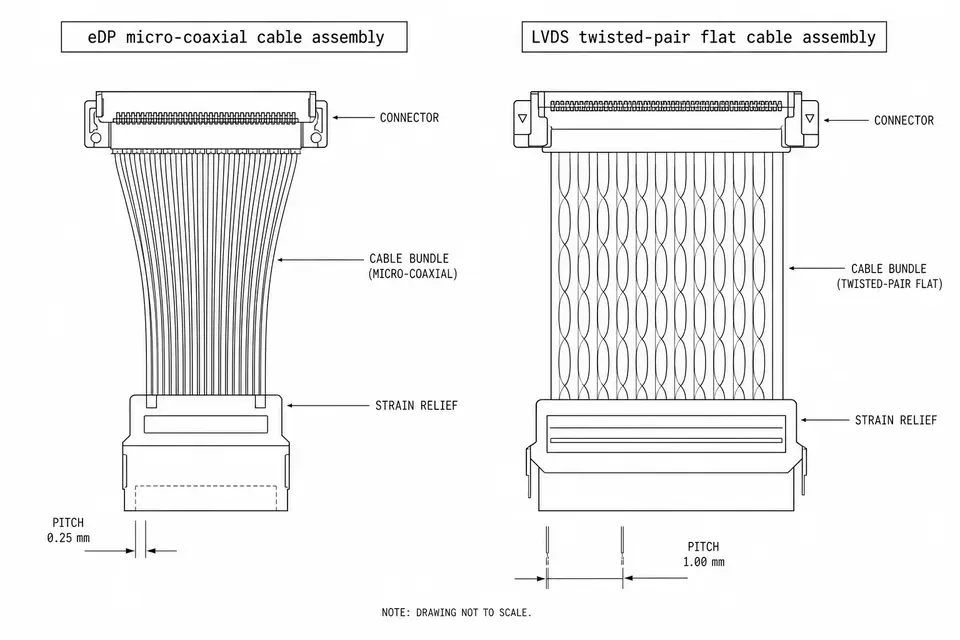
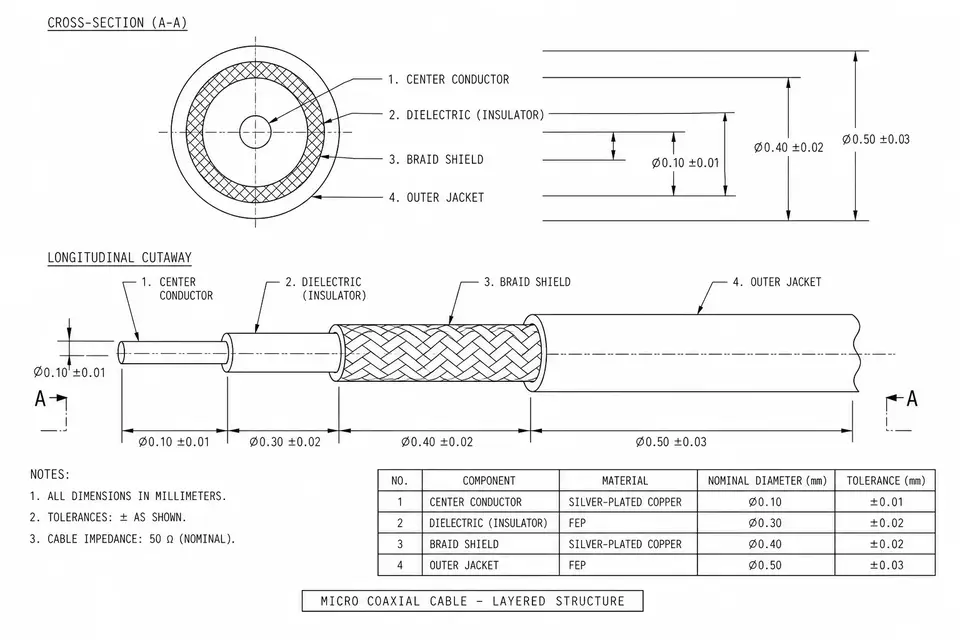
For eDP and LVDS assemblies, identify each signal group and its requirement from the actual board, panel and interface documentation. Do not apply one impedance target to every conductor. In micro-coax assemblies, the single-ended impedance of one coax and the differential impedance of a pair describe different measurement conditions. Do not assume that two nominally 50 ohm paths automatically establish an acceptable 100 ohm differential assembly; coupling, transitions and the measurement mode matter. See Tektronix differential TDR guidance for the distinction between measurement modes.
For target selection, use 90 ohm vs 100 ohm. For an agreed assembly measurement scope, see RF Impedance Testing. These are separate decisions from choosing the display interface.
5. Impedance Control from Drawing to Production, Step by Step
In a real project, impedance control runs as one connected thread:
- Confirm the target impedance from the interface spec or drawing
- Define the context — single-ended, differential, or coaxial
- Fix the connector, cable, length, shielding, and termination method
- Build samples, with the termination window kept under control
- Test by TDR, VNA, or another agreed method
- Tie the test records to the drawing revision, sample version, and lot
- In production, sample at an agreed rate or keep first/last-piece records
The step most often skipped — and the one most worth holding — is number 6. If a report isn't matched to a version and a lot, a later problem is hard to pin on structure, process, or a device-side change.
6. Stating Impedance Clearly in an RFQ
One line won't do; it helps to list the whole set: target impedance (e.g., 100 ohm differential / 75 ohm single-ended), tolerance (e.g., ±10%, per the drawing), test method (TDR / VNA or a specified method), test conditions (frequency range, rise time, fixture, report format), cable structure, connector, cable length, and whether reports ship with the goods. If the target impedance isn't set yet, go back to the system or interface side first — manufacturing can judge manufacturability and test method, but it can't define the interface target.
7. Related Applications and References
- eDP Cable Assemblies
- LVDS Cable Assemblies
- Micro-Coaxial Cable Assemblies
- RF Impedance Testing
- References: TI LVDS Signal Path Design, VESA eDP 1.4a Overview, I-PEX CABLINE-CA
8. Which Test Answers the Question?
| Check | Evidence it provides | What remains open |
|---|---|---|
| Continuity and pin map | Required connections and wiring assignment | High-speed reflections and loss |
| TDR with a defined measurement mode | Reflection response and apparent impedance along the test path | Frequency limits and complete system operation |
| VNA with defined ports and reference planes | Return loss and insertion loss across the agreed band | Pass/fail without an agreed mask; device validation |
TDR and VNA instruments can support additional derived views; the table describes the requested result, not an exclusive instrument capability. Tektronix's TDR primer explains fixture effects and the relationship between time- and frequency-domain results. Samtec's impedance discussion explains why connector transitions and insertion loss also belong in the signal path review.
9. Worked Decision Example: Cable Body or Whole Assembly?
This is a hypothetical drawing and report, not an EDPcable test result or a universal interface tolerance. Assume a drawing specifies 100 ohm differential with a 10% tolerance, giving a 90 to 110 ohm interval. A report shows 96 to 104 ohm over the cable body and a 112 ohm peak near the connector.
If the approved method applies that interval to the whole measured assembly, the peak is outside the stated interval. Do not average it into the cable-body result. If a documented method excludes connector regions, the body can meet its own requirement, but this does not approve the connector or the full channel. Without a defined window, rise time and treatment of measurement uncertainty, hold acceptance and clarify the method. The numbers alone do not prove the connector is defective.
Repeat the connection under the same setup, compare both ends where the agreed method allows, and check fixture/reference-plane settings before changing the assembly. A smoother trace obtained by changing filtering is not comparable evidence unless the specified method permits it.
10. Decision Checklist Before Accepting an Impedance Report
| Required record | Review question | Hold acceptance when |
|---|---|---|
| Drawing and specimen identity | Do revision, length, pair and lot match? | Report belongs to another configuration |
| Signal mode and target | Single-ended or differential; which return path? | Only a bare ohm value is supplied |
| Test boundary and mask | Are cable body, connectors and excluded regions identified? | A body-only result is presented as assembly approval |
| Setup and calibration | Are fixture, reference planes, rise time/filter or frequency band recorded? | Two reports use incomparable conditions |
| Raw trace and repeatability | Are excursions retained and reconnection checks recorded? | Only an average or an unexplained screenshot is supplied |
| Acceptance and next validation | Are limits, uncertainty handling and device checks agreed? | Cable-level evidence is treated as system certification |
Rise time at the device under test can differ from the instrument setting because the test path affects the step. See Tektronix on TDR resolution. Record the actual agreed setup instead of inventing a universal picosecond or percentage limit.
Send the drawing revision, connector part numbers, pair/ground map, finished length and routing, operating interface, target and tolerance, proposed test boundary and report requirements with the cable assembly RFQ. Define sampling and any post-bend or environmental checks for the project; a passing sample report does not set a production sampling plan.