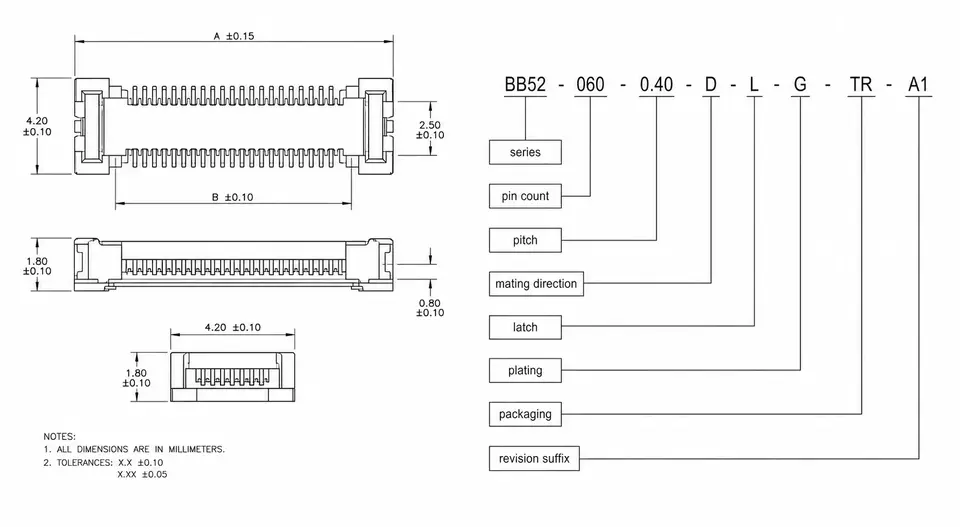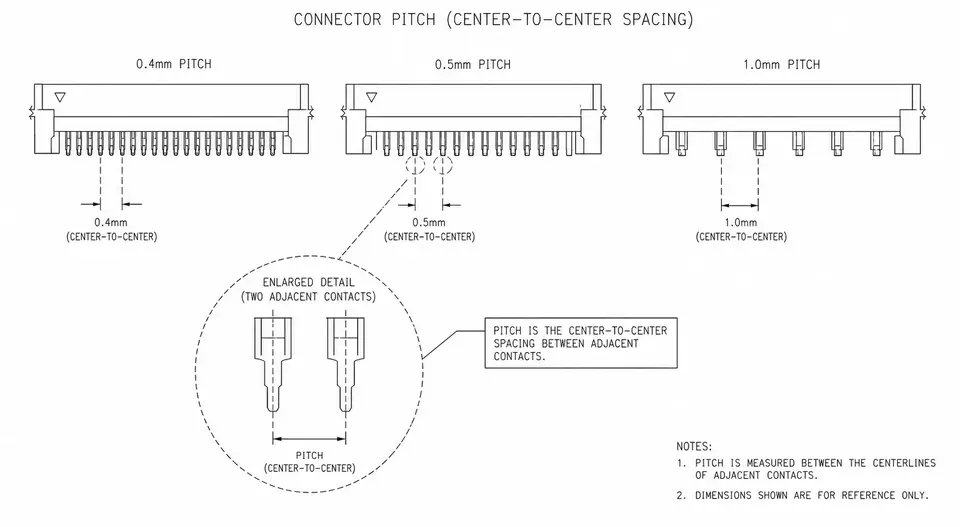
Start with the contact pattern and drawing
Connector pitch is the center-to-center spacing of adjacent contacts in the direction defined by the connector drawing. It is not the air gap between metal surfaces or the width of the housing. For a regular single row, the measured center span divided by the number of intervals estimates pitch. For multiple rows or staggered contacts, identify the pattern and axis first; do not divide a distance by the total contact count without checking what it represents.
The TE Connectivity FPC guide explains centerline spacing and illustrates staggered tail arrangements. That example is a reminder to read the particular drawing, not a rule that every connector has the same contact or tail pattern. Preserve the drawing revision and the view used for each measurement.
| Dimension | What to identify | What it does not establish |
|---|---|---|
| Contact pitch | Repeated contact centers along the specified axis | Compatible series or pin assignment |
| Row spacing and offset | Distance between rows and any stagger | A single-row pitch from a diagonal distance |
| PCB termination spacing | Land or tail pattern on the board drawing | The mating-face pitch in every design |
| Cable conductor pitch | Conductor pattern at the cable termination | Cable thickness, exposed length or contact side |
A two-row measurement example
Assume an unpowered, disconnected sample has 16 contacts arranged as two straight rows of eight. In one row, the center of the first contact to the center of the eighth measures 8.75 mm. There are seven intervals in that measured span, so the estimated pitch is 8.75 / 7 = 1.25 mm. Dividing by 15 because the housing contains 16 contacts would describe neither measured row correctly. Record row spacing separately; do not substitute the diagonal to a contact in the other row.
This is an illustrative calculation, not a measured EDPcable assembly or an inspection tolerance. A hypothetical 1.27 mm pattern spans 8.89 mm over the same seven intervals, a 0.14 mm difference. That accumulated difference can help distinguish candidates, but caliper resolution, contact damage and uncertainty still matter. If the reading does not resolve the candidates, obtain the original drawing or use suitable optical measurement; do not force a mating trial to identify the part. Avoid pressing a tool onto delicate contacts.
Matching pitch is one entry in the selection record
Hirose DF13 and Hirose DF14 are both described by their manufacturer as 1.25 mm pitch crimp connector families. The common spacing is not authorization to cross-mate them. Identify the complete part numbers, housing, terminal and specified mating counterpart, then compare the appropriate drawings and application instructions.
For FFC/FPC interfaces, matching conductor spacing also leaves cable thickness, contact side, exposed contact length, insertion direction and retention details to resolve. Use the dedicated FFC pitch selection guide for the cable geometry, and connector part-number guide for the full ordering code. A board tail layout is not automatically a cable specification.
Six checks before approving the connector choice
| Check | Evidence to collect | Pause the selection when |
|---|---|---|
| Pattern and identity | Dimensioned views, rows, contact count, axis, full part numbers | A photograph or pitch estimate is the only identification |
| Mating pair | Manufacturer mating list, keying, latch, orientation and pin-1 view | A similar-looking housing is treated as a substitute |
| Cable and termination | Approved terminal, wire range or FFC drawing, thickness and contact side | Only nominal pitch has been matched |
| Electrical conditions | Exact part ratings, loaded circuits, wire, temperature and application limits | Current, voltage or signal suitability is inferred from pitch alone |
| Assembly and handling | Applicable crimp, solder, IDC or actuator instructions and tooling | A universal process is assigned to every 0.3 mm or 2.54 mm part |
| Verification and release | Approved pin map, continuity/shorts checks, retention and application test plan | Fit or continuity is presented as complete electrical or lifetime qualification |
Pitch can influence packaging options, but it does not supply a universal current rating, mating-cycle life, yield or cost. A finer pitch does not by itself mandate laser stripping; a coarser pitch does not remove tooling or inspection requirements. Select and verify the actual component system under its stated conditions. Component documentation does not validate the finished cable assembly or device.
Send a drawing-based RFQ
Provide the two complete connector codes, mating-board references, dimensioned views and revisions, pin-1 orientation, cable construction, length, routing, operating conditions, quantities and required verification records. Mark unidentified features as open questions. For an adapter between different pitches, define both interfaces and the pin map independently before releasing a prototype.
Review the relevant FFC/FPC pitch assembly page, IDC pitch options or fine-pitch micro-coax page with those requirements. Request a component and verification review instead of an unsupported promise that every equal-pitch connector is interchangeable.