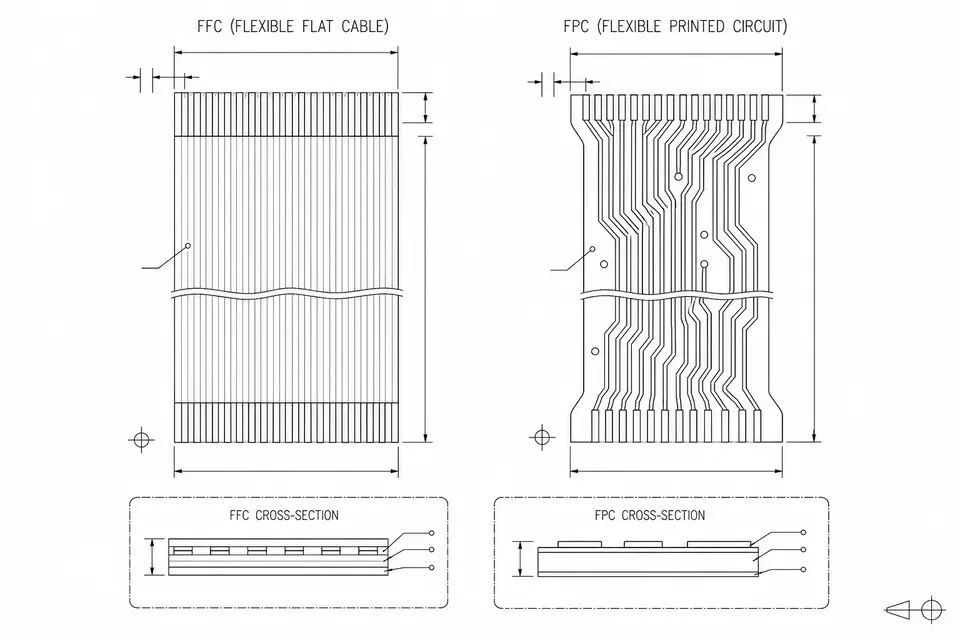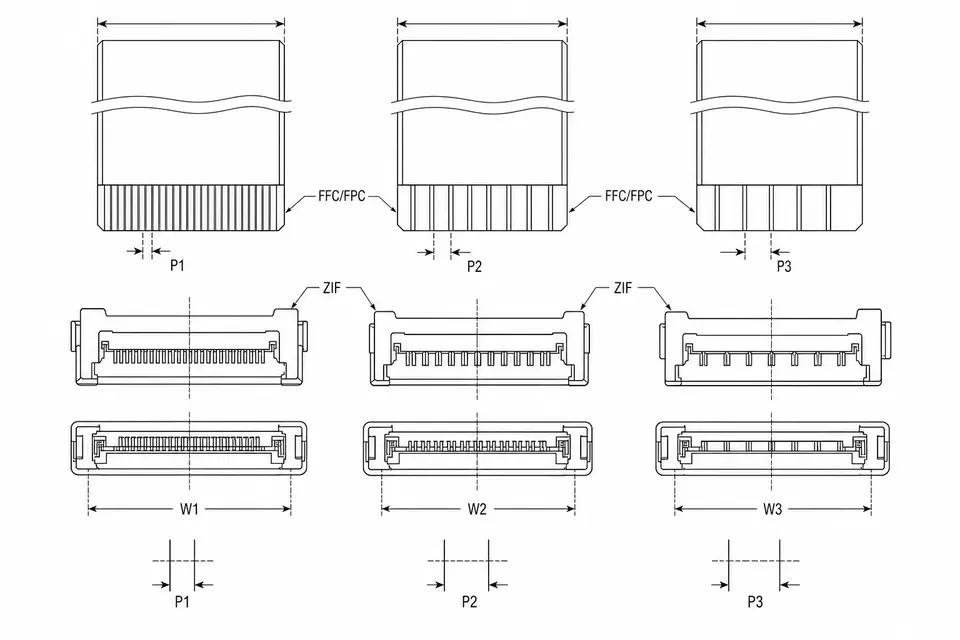
Choose FFC pitch by matching the exact connector at each end, then check the complete cable-end drawing, current conditions and installed width. A matching pitch and contact count do not establish interchangeability. For an unidentified sample, measure across several conductor centers before comparing it with the manufacturer drawing.
What Pitch Actually Decides
Pitch is the center-to-center spacing between adjacent contacts or conductors. It does not by itself define conductor width or thickness, cable thickness, current rating, exposed-contact geometry, stiffener or total assembly width. Molex's FFC/FPC connector portfolio and TE's FFC connector FAQ organize products by several attributes because pitch is only one part of the mating definition.
Step 1: Start with the Board-Side Connector
Start with the exact board-side connector. ZIF, non-ZIF, slider and flip-lock implementations can impose different insertion and cable-end requirements. Ask:
- What full receptacle part number and application specification control the design?
- What pitch, contact count, top/bottom or same/opposite-side contact orientation, cable thickness and exposed-contact geometry does it accept?
- What stiffener, insertion depth, keep-out, actuator operation and mating-cycle requirement applies?
- What current/voltage rating and environmental conditions apply to that exact connector and contact population?
- What manufacturer lifecycle or change information is available for the exact series?
If the board connector is fixed, the task is to create a matching cable-end definition, not to select pitch independently.
Step 2: Check Current Headroom
Current is a connector-and-cable-system decision. Collect the exact conductor dimensions and material, connector contact rating, number and location of loaded contacts, ambient/enclosure conditions, temperature-rise criterion and applicable derating. Do not assume that a coarser pitch automatically supplies a particular current margin.
If contacts are paralleled, define current sharing, sequencing, return conductors and the failure case; pin count alone does not make a safe power path.
Step 3: Do the Width Math
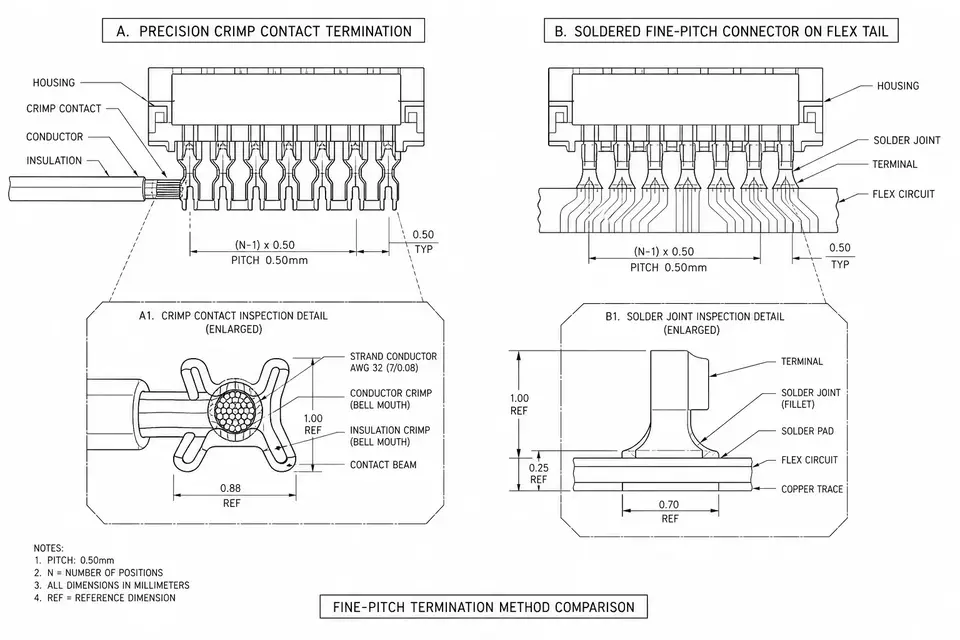
For N conductors at pitch p, the centerline span from the first to last conductor is (N - 1) x p. That is not total cable width. Add the defined conductor width and left/right edge margins from the cable drawing; use the connector drawing separately for housing and board-space dimensions.
| Dimension | Derive or obtain from | Common mistake |
|---|---|---|
| Conductor centerline span | (N - 1) x pitch | Using N x pitch |
| Total cable width | Cable drawing: conductor geometry plus edge margins | Treating centerline span as finished width |
| Connector envelope | Receptacle drawing and PCB layout | Assuming it equals cable width |
| Exposed-contact length and insertion datum | Connector application specification | Copying from another series with the same pitch |
| Stiffener thickness/length | Connector/cable compatibility data | Treating all FFC at one pitch as interchangeable |
Measure Pitch Across Gaps, Then Check Finished Width
Count the conductors and measure between the centers of the first and last conductor in a straight, undamaged contact area. With N conductors and measured span S, the estimated pitch is S / (N - 1). Use magnification or a suitable measuring fixture if the centers cannot be resolved; keep the measurement uncertainty with the result. Do not identify pitch by jacket width alone.
For an illustrative 20-conductor sample, a 9.50 mm centerline span gives 9.50 / 19 = 0.50 mm. A 19.00 mm span over the same 19 gaps gives 1.00 mm. These are nominal geometry examples, not inspection tolerances or approval of a replacement cable. Confirm the result against both connector drawings and the cable specification.
Finished width is a separate dimension. If a hypothetical 0.50 mm-pitch, 20-conductor drawing specifies 0.30 mm-wide conductors and 0.35 mm margins measured from each outer conductor edge, its nominal width is 9.50 + 0.30 + 0.35 + 0.35 = 10.50 mm. Different conductor widths or margins give a different result at the same pitch. Check tolerance stack-up and connector envelope separately; do not add cable width to connector width as a universal board-space formula.
The GCT assembly definition guide treats pitch, conductor dimensions, contact side and cable length as separate ordering fields. Its drawings, rather than this worked example, control a GCT part. Likewise, the Hirose FH12 series has several contact and mounting variants; obtain the exact item's recommended cable-end drawing rather than treating a family name as a mating approval.
Two Factors That Get Missed
Insertion process. Alignment, actuator operation, insertion datum, cable-end flatness, stiffener and accessibility affect assembly. Define the process for the selected connector; there is no universal pitch threshold at which manual insertion stops being acceptable.
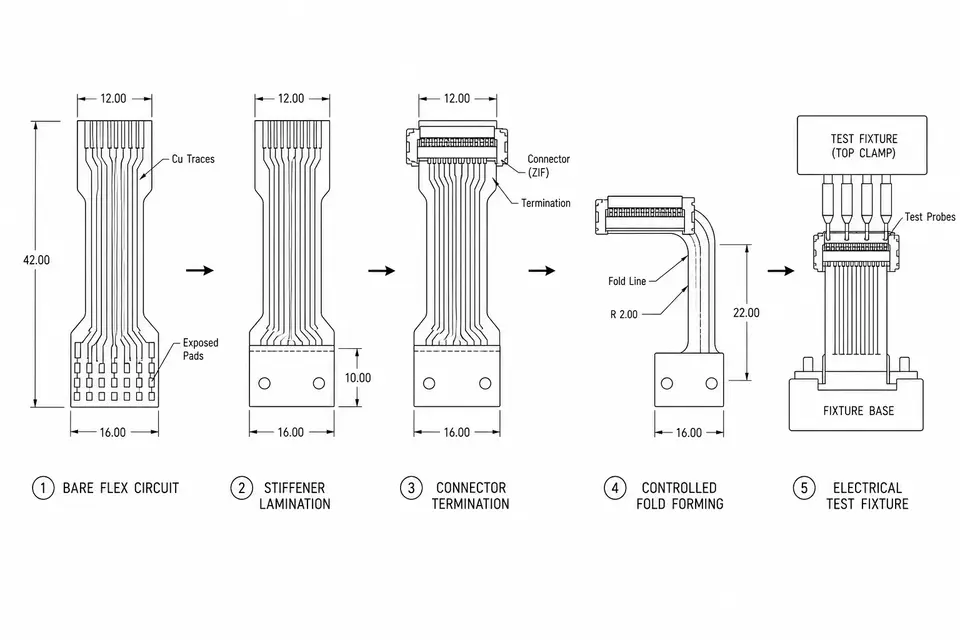
Routing and reinforcement. Exposed length, contact orientation, stiffener, bend keep-out, fold line, motion and expected mating/service operations should be on the drawing. Validate the installed cable rather than treating small pitch as a proxy for fragility.
Release Checklist: Evidence and Hold Conditions
| Check | Evidence to record | Hold the release when |
|---|---|---|
| Mating pair | Full connector numbers at both ends and controlled drawings | Only pitch, pin count or a photograph is available |
| Pitch and width | Measured conductor-center span, count, uncertainty and dimensioned cable width | A jacket-width shortcut is the only identification |
| Contact and circuit orientation | End A/B views, exposed sides, pin 1 and complete wire map | A Type A/B label is not tied to a drawing view |
| Insertion geometry | Finished end thickness, exposed length, stiffener and insertion datum | The latch must be forced or seating is inconsistent |
| Electrical loading | Loaded-contact pattern, conductor construction, connector/cable ratings and temperature-rise plan | A current claim is inferred from pitch or parallel pin count |
| Installed route and process | Bend keep-outs, actuator access, strain relief, assembly and qualification records | Continuity passes but fit, retention or motion remains unverified |
Use a controlled first article to check seating and circuit mapping in the actual mating pair. Qualify temperature rise, retention and motion against the project's own limits where applicable. A continuity result cannot replace those checks, and a component catalog does not qualify the finished assembly.
For an RFQ, send both connector numbers, the cable drawing revision, contact-side views, nominal dimensions and tolerances, pin map, loads and ambient conditions, route/motion requirements, sample quantities and acceptance criteria. Mark unresolved fields explicitly and request a drawing review before ordering production material. Use the 0.5 mm / 1.0 mm FFC application page for manufacturing discussion and build-to-print controls for the controlled inspection package.
Moving from Method to Part Number
This article covers the decision sequence. For specific pitch ranges, conductor-count options and manufacturing details, use the application pages: Fine-Pitch FFC for compact signal links, and 0.5mm / 1.0mm Pitch when the decision is mainly between those two common sizes. If the question is whether the project should be FFC or FPC at all, start with FFC vs FPC.
Before release, use build-to-print process controls to define cable preparation, stiffener/contact inspection and insertion checkpoints. Use electrical test planning for wire-map checks; those checks do not prove connector retention, temperature rise or flex life.