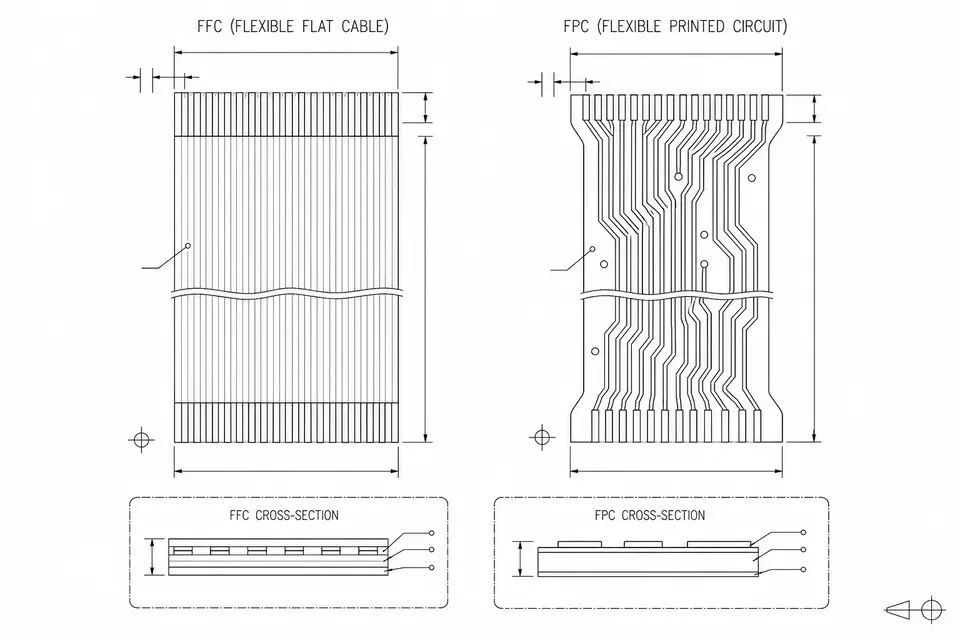
It Enters as Flex and Leaves as a Part
FPC fabrication creates the circuit pattern, insulating structure and outline. Assembly adds the specified terminations, components, local support and installed form. A bare mating tail may need no soldering; a populated flex may need carrier-supported SMT. PICA’s FPCBA process guide describes one populated-flex route with inspection, supported placement and reflow. It is a useful example, not a mandatory sequence for every flex interconnect. The six work areas below are a review framework; the released drawing and validated process plan control the actual order. Dimensions in the line drawing are illustrative, not product specifications.
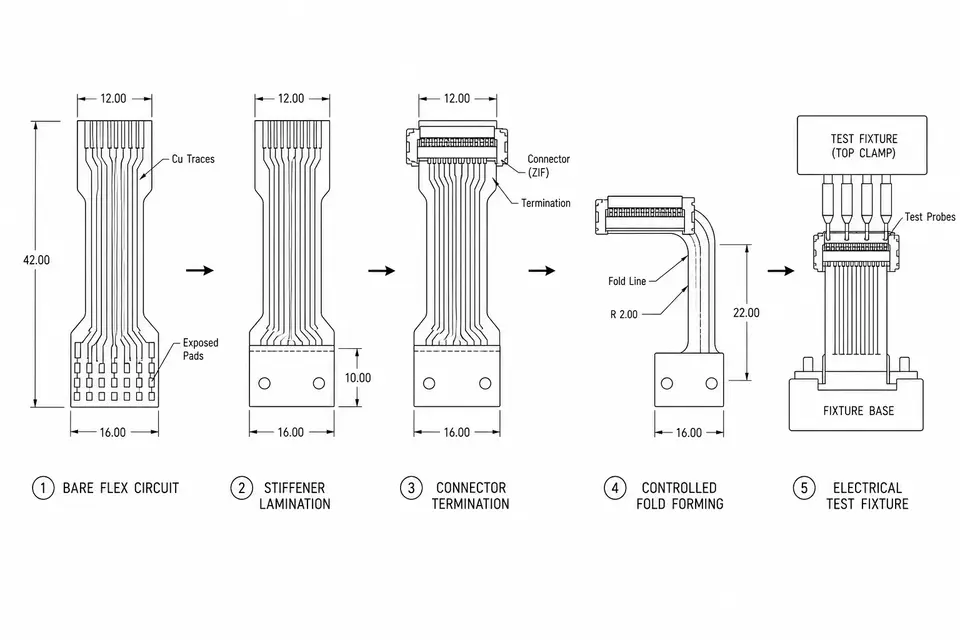
Open the complete process illustration
Station 1: Incoming Inspection
The bare flexible circuits from the flex supplier are checked first: trace continuity, outline dimensions, surface finish and obvious cosmetic defects. The reason is simple. If an etching defect or plating issue is found after termination, the scrap cost is much higher. Batch samples and traceability records also start here.
Station 2: Stiffener Lamination
A stiffener is a local rigid backing. Its need, material, position and thickness follow the drawing and mating-part requirements. At a connector tail, review the total insertion thickness, including any adhesive and stiffener. A supported soldering or component zone may also be required, but neither location makes a stiffener universal. It may already be fitted by the circuit supplier. Confirm which supplier owns attachment and inspection, and validate its position and bonding process without assuming it must always be attached before termination.
Station 3: Termination
Termination follows the drawing and usually lands in one of three forms:
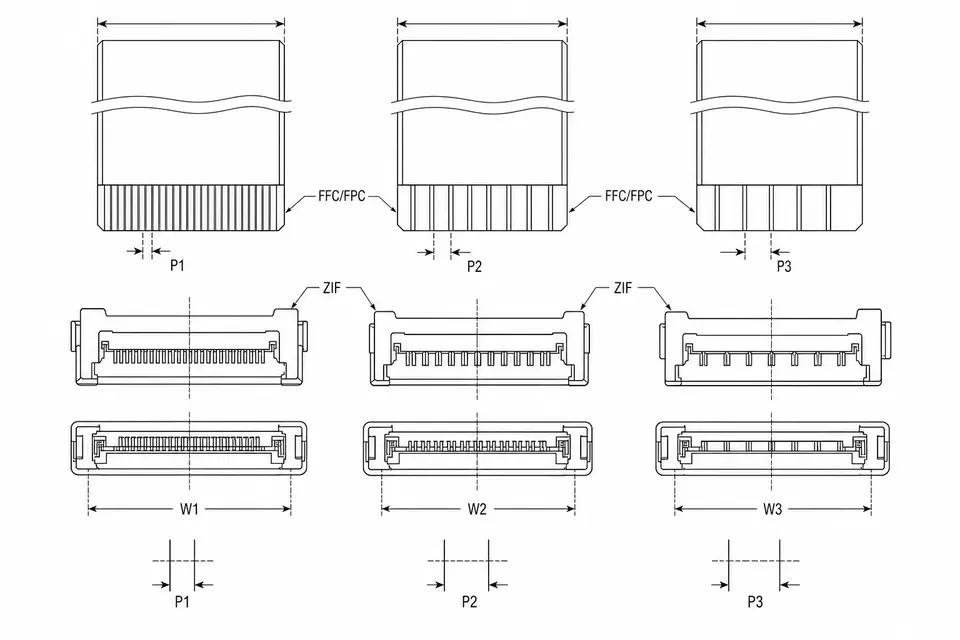
- Bare ZIF end - the end of the flex is itself the contact area, and the stiffener brings it to the required insertion thickness.
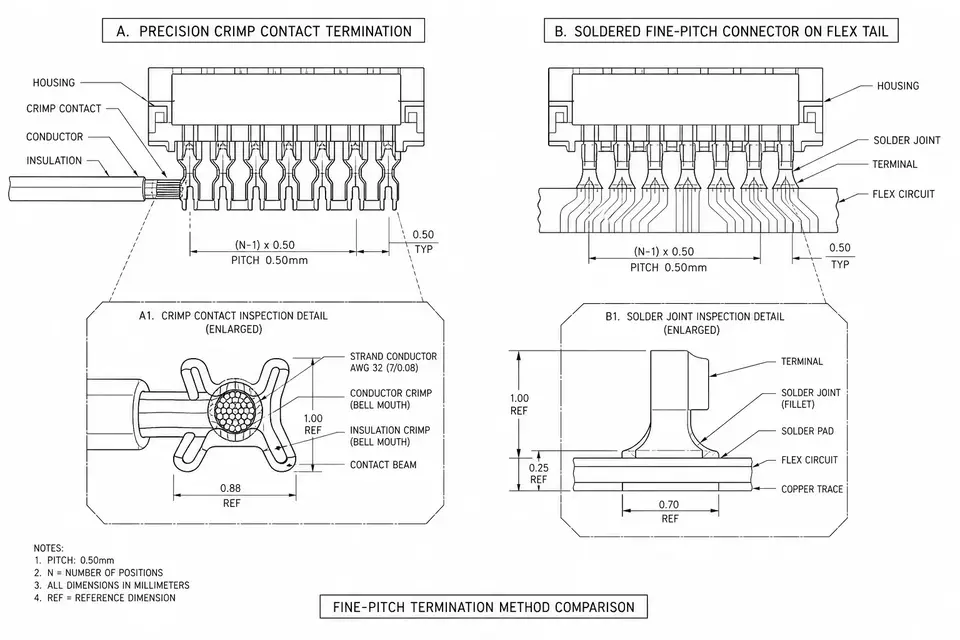
- Soldered connector - a board-to-board or wire-to-board connector is soldered to the flex; fine-pitch versions may use hot-bar or selective soldering.
- Transition to round wire - when the signal path leaves the flat area, the flex transitions to round conductors. The anchoring and strain relief at that joint are their own design problem, covered more directly in FPC-to-Wire Hybrid.
Fine-pitch crimping and soldering each have limits; the comparison is covered in Crimping vs. Soldering at Fine Pitch.
Station 4: Folding and Forming
Define the installed shape, length datums, bend zones and support on the drawing. Keep bending loads away from terminations and component areas according to the approved design. The process plan may form the part after flat assembly work or use dedicated fixtures earlier; review access, handling and thermal constraints before fixing the order. Distinguish an installation bend from repeated service motion. Neither the FPC name nor a continuity pass establishes a safe universal bend radius or fatigue life.
Station 5: Electrical Test
After forming, the assembly goes onto a test fixture. The baseline is full-net continuity plus isolation: opens from cracked traces and shorts from bridges are stopped here. If the drawing calls for impedance, resistance or withstand-voltage checks, those are added. Test data is logged by batch because it becomes the basis for later traceability.
Station 6: Visual Inspection and Packaging
Final inspection checks solder shape, stiffener edges, alignment and any whitening or cracking near fold lines. Packaging then protects the part from sharp compression. For flex assemblies, the last risk is often a dead fold during shipment, so trays and separators are part of the manufacturing control, not decoration.
When You Read a Process Flow
Ask the supplier to identify the actual operation sequence, outsourced steps, fixtures, inspection points and record ownership. A different sequence is not automatically defective; it needs evidence that support, access and final requirements remain controlled. Specify which checks apply to each unit and which belong to first-article or qualification sampling.
- FFC / FPC Cable Assemblies
- FPC-to-Wire Hybrid
- Further reading: FFC vs FPC, Choosing FFC Pitch
FPC assembly checks at each work area
| Area | Evidence | Hold if |
|---|---|---|
| Incoming flex | Drawing revision, outline and circuit records | Material or revision differs |
| Local support | Tail thickness and stiffener position | Mating-end specification is not met |
| Termination | End views, net map and process plan | Contact side or map is uncertain |
| Forming | Installed drawing and fixture review | Load reaches a joint or pad |
| Electrical checks | Net list, method and acceptance limits | Open, short or mapping error appears |
| Final packing | Dimensions, handling and packing plan | A sharp fold or contact damage is possible |
For a ZIF tail, pitch alone is insufficient. The Hirose FH12 family includes different contact and mounting variants. Check the exact mating-part drawing and insertion instructions for contact side, end geometry and actuator access. Do not infer compatibility from a blue stiffener or force a lock closed.
RFQ and first-article handoff
Send the circuit and assembly drawings, net list, mating-part numbers, stack-up, outline, end views, local support, component list where applicable, installed route, quantity and test requirements. For an FPC-to-wire hybrid, define the wire end and strain relief as well as the flexible circuit.
Agree the first-article evidence before sampling: dimensional results, mating check with the specified parts, electrical mapping results, photographs of critical features and an approved packing method. Separate these release checks from any motion, environmental or channel-performance qualification. Continuity and isolation detect defined electrical faults; they do not prove solder quality, flex life or complete system performance. Use the electrical testing planning page to define the scope rather than treating the label “tested” as an acceptance limit.
Reference
- TE Connectivity introduction to fine-pitch FPC connectors — manufacturer guidance on centerline, actuator, contact, and insertion options that must be confirmed before termination or formed-route review.