What does cable shielding do?
A cable shield is a conductive structure intended to reduce interference coupling into or out of a cable. Its effectiveness depends on the interference source, frequency, geometry, shield construction and return path. Specify the shield together with both connector ends and the enclosure bond; a material name or coverage percentage does not establish installed EMC performance.
Electric-field coupling, magnetic-field coupling, common impedance and radiation are different problems. First identify the source and victim, then choose the construction and verification method. A cable that works on an open bench may behave differently beside a switching supply or through an enclosure entry.
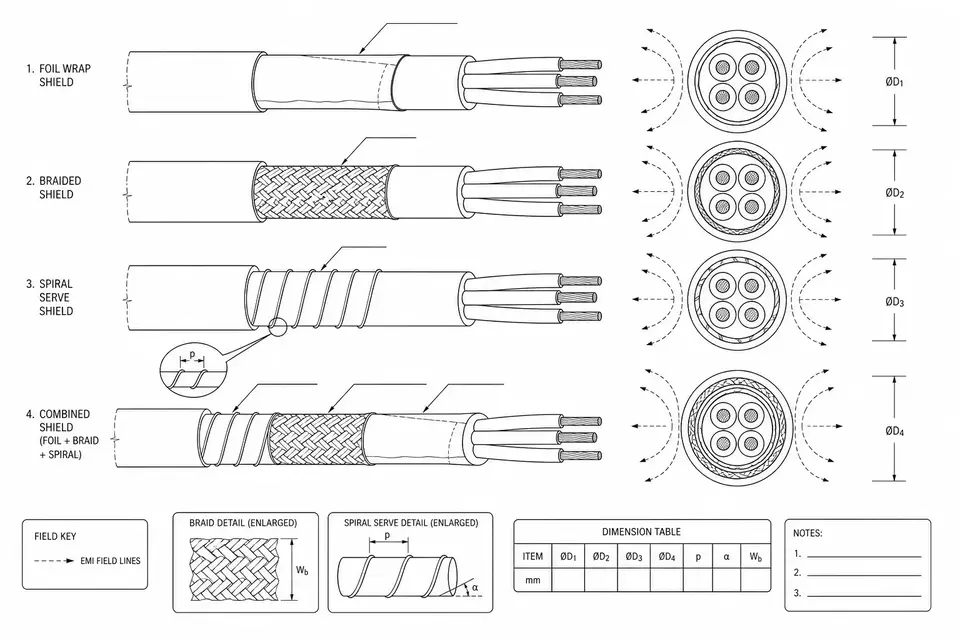
Foil, braid, spiral and combination shields compared
| Construction | Details to put in the drawing or RFQ | What the name does not establish |
|---|---|---|
| Foil: conductive film or laminated tape | Material, overlap, conductive side, drain/contact method and exposed length | Guaranteed attenuation, universal frequency limit or static-only use |
| Braid: interwoven conductive strands | Strand material, optical coverage, diameter, termination and installed bend | Immunity to fatigue or a shielding-effectiveness value |
| Spiral/serve: strands wound in one direction | Lay, coverage under movement, contact method and qualified motion | Suitability for every micro-coax cable or all continuous-motion routes |
| Combination: more than one shield layer | Layer sequence, individual/overall shielding and connection of each layer | Automatic superiority regardless of diameter, connector or routing |
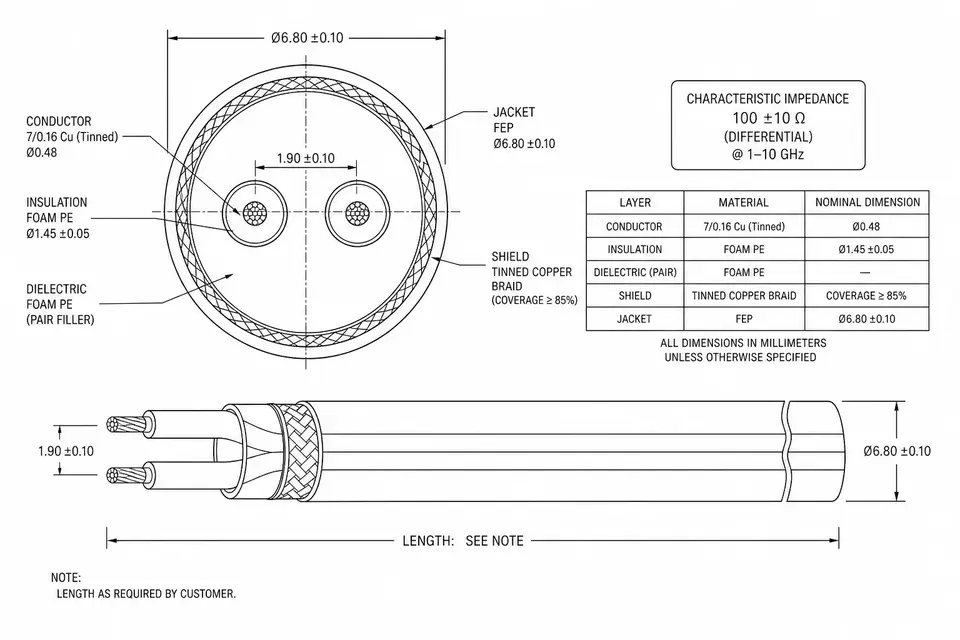
For a concrete specification example, Alpha Wire 6391 lists foil overlap, foil orientation, a drain and minimum braid coverage separately. Those are construction details, not an installed attenuation result.
Avoid a blanket “foil cannot flex” rule. Belden's flex-cable matrix includes both foil/spiral and foil/braid constructions. Request the exact part's motion conditions; its rating does not qualify a different finished harness.
Coverage, continuity and EMC measure different things
Optical coverage describes geometry. DC resistance and continuity describe the conductive path. Shielding effectiveness describes attenuation under a stated frequency range and method. Transfer impedance characterizes coupling through a shield under specified conditions. Do not replace one requirement with another or compare numbers measured with different setups.
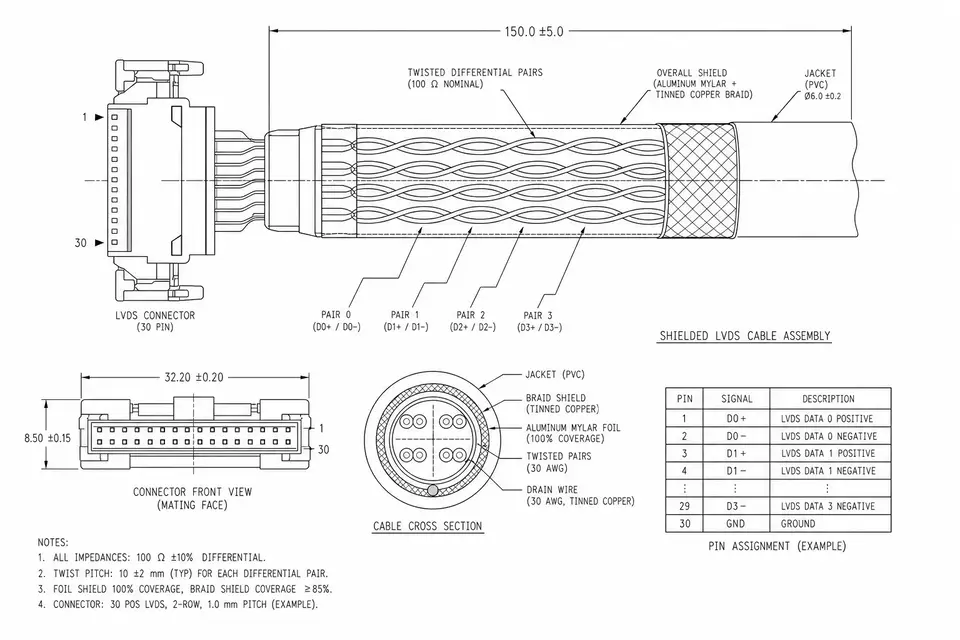
A drain wire can provide contact to foil in a construction designed for it. It does not make a long exposed termination equivalent to a circumferential bond. TE's Tinel-Lock example demonstrates a 360-degree braid-to-backshell connection. This is a component design example, not proof that any assembly using a circular clamp will pass EMC.
One end or both ends: define the return path
Use the equipment/interface manufacturer's bonding instructions and the product's grounding design. Record the connection at each end, including shell-to-chassis contact, deliberate isolation and intermediate joints. Signal return, chassis and protective earth are distinct functions; a shield is not automatically an approved protective conductor. Neither “always one end” nor “always both ends” resolves every signal, enclosure and ground-potential problem.
For a high-frequency problem, review exposed shield length and termination geometry before prescribing a new cable material. A pigtail adds an inductive path, but there is no universal dB penalty or safe length independent of the installation.
Worked diagnosis: two 300 mm display harnesses
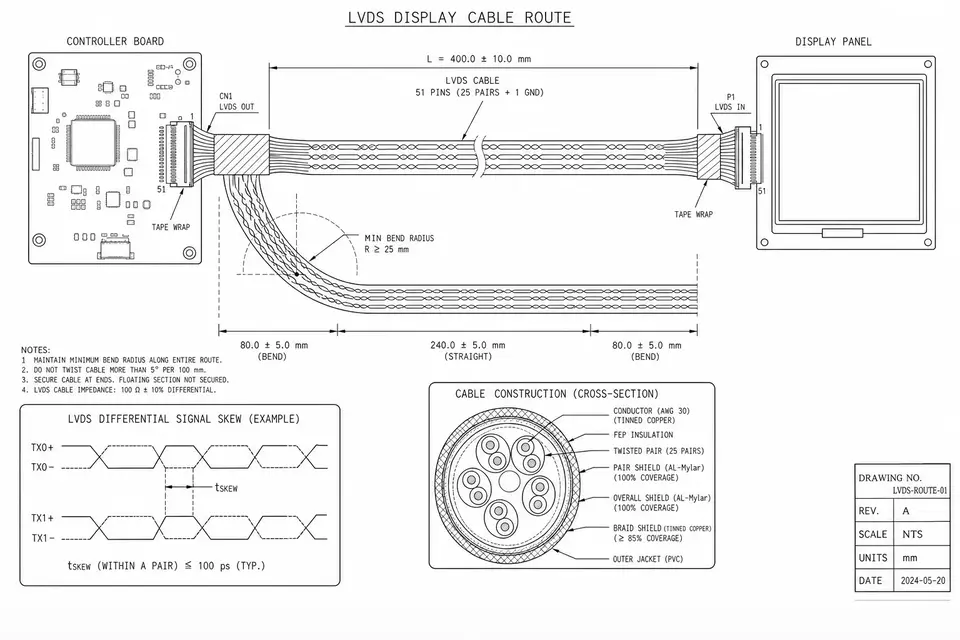
This is a hypothetical planning example, not an EDPcable test result. Harness A and B use the same 300 mm foil/braid cable. A drawing specifies a circumferential shell bond; B brings the shield through a 40 mm exposed drain lead. Both could pass a DC continuity check. That check alone cannot decide which meets the equipment's EMC limits. The 40 mm dimension is an example, not an acceptance threshold.
Keep cable type, equipment, route, source activity and test setup constant. Compare the approved termination configurations one variable at a time, recording emissions/immunity response and functional errors before and after the specified motion exposure. If the source or limit is unknown, hold the design decision rather than assigning an invented attenuation improvement. Review the actual route with Shielded LVDS Routing.
Six checks before releasing a shielded assembly
| Evidence to retain | Acceptance question | Hold when |
|---|---|---|
| Interference/source description | Are source activity, affected function and relevant frequency range defined? | Only “needs better shielding” is supplied |
| Exact cable construction | Are layers, material, coverage and part revision recorded? | Only a generic shield name is available |
| Endpoint/bond drawing | Are both ends, exposed lengths and chassis interfaces controlled? | Drain, shell and signal return are confused |
| Mechanical route and duty | Do bend, torsion and motion tests match the installation? | A bare-cable rating is used as assembly proof |
| Electrical inspection record | Are shield continuity and unintended shorts checked to the drawing? | Continuity is claimed to prove EMC |
| Installed EMC/functional report | Are setup, limits, operating modes and results retained? | An improvement is asserted without a comparable test |
What to send with the RFQ
Send the cable part or construction, connector and backshell parts, pinout, shield layers, both-end bonding diagram, exposed-length dimensions, route and motion duty, source/victim description and required validation. Ask for deviations to be identified before manufacture. Use build-to-print process controls for preparation checkpoints and electrical test planning for continuity criteria. The related high-shielding micro-coax page covers application definition, while impedance control addresses a separate signal-path requirement.