1. What Laser Stripping Does
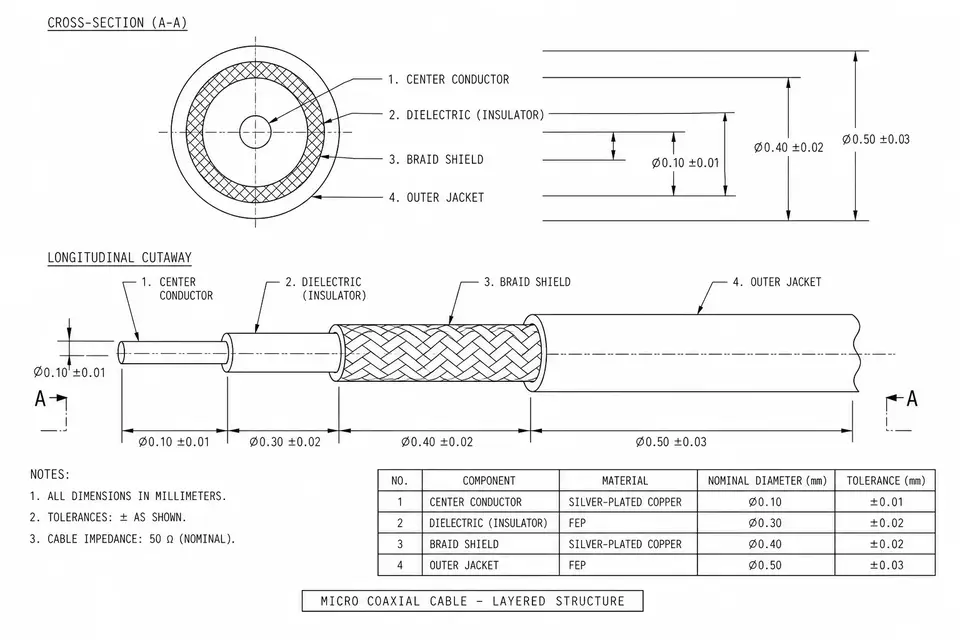
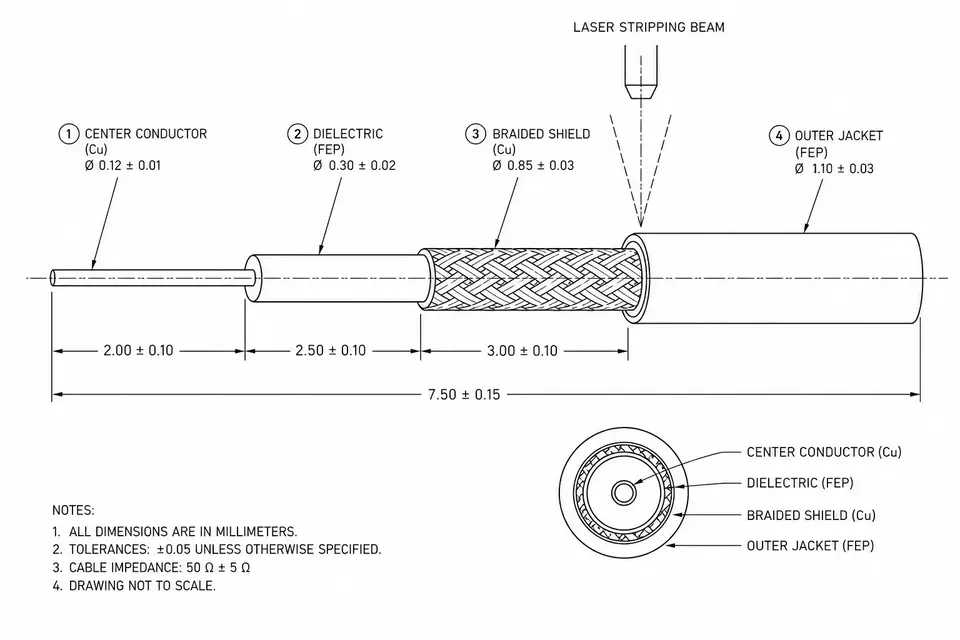
Laser stripping uses focused light to cut or remove a selected cable layer before termination. Micro-coax commonly has an outer jacket, metallic shield, dielectric and center conductor. Preparing these layers requires separate locations and acceptance criteria. Removing insulation and cutting a metal shield are different operations; one recipe should not be assumed to handle both.
A non-contact beam removes blade contact from that operation. It does not establish that the remaining conductor, plating or dielectric is undamaged. Laser Wire Solutions' process FAQ explains that the technology, wavelength and parameters must match the insulation and conductor combination.
2. Choose the Process from the Construction
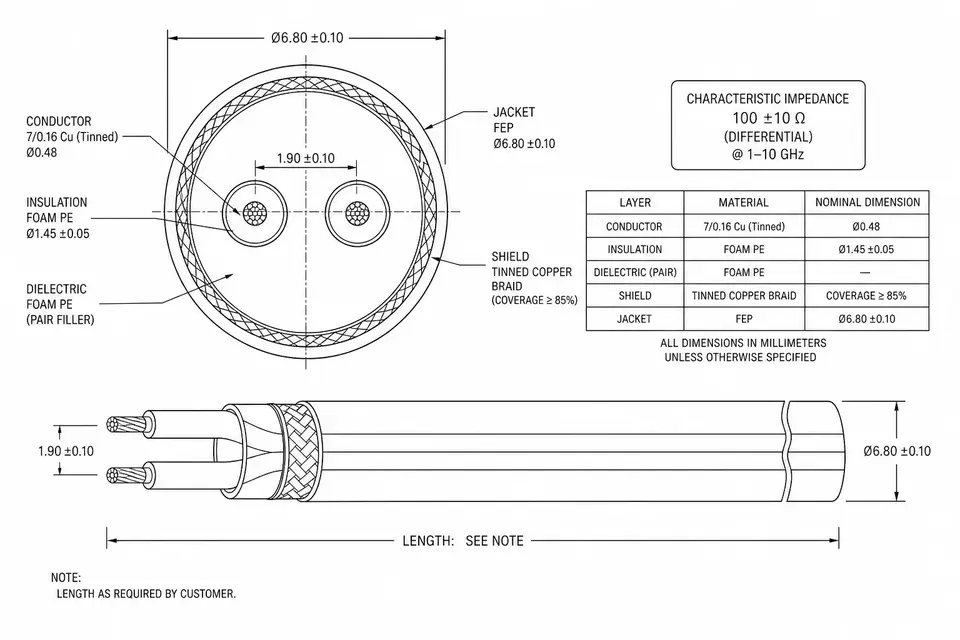
There is no universal 40 AWG or 0.25 mm connector-pitch threshold that makes laser stripping mandatory. Conductor gauge, cable outside diameter and connector pitch describe different features. Obtain the cable drawing and actual samples before comparing methods.
| Decision input | Laser trial | Mechanical trial |
|---|---|---|
| Layer material and adhesion | Check absorption, removal and residue on actual material | Check cutting and pull-off behavior on actual material |
| Shield and dielectric geometry | Qualify each removal boundary and underlying layer | Qualify blade depth, centering and pull-off effects |
| Cable or ribbon positioning | Verify fixture location and presentation repeatability | Verify guides, clamping and tool alignment |
| Production requirement | Compare accepted output, inspection and handling time | Compare accepted output, tool maintenance and handling time |
Compare inspected samples made to the same drawing. A cleaner-looking surface alone does not establish electrical performance or production yield. This is an engineering selection method, not a claim that either process is qualified for a particular EDPcable assembly.
3. Separate Jacket, Shield and Dielectric Operations
The manufacturer's micro-coax process overview describes a system using CO₂ for polymer layers and UV for shield cutting. That is one equipment architecture, not a universal recipe for every polymer, plating or shield construction.
First define the required exposed regions from the termination drawing. Then trial the actual material stack with controlled position, focus, energy delivery and pass sequence. Include fixture condition and the extraction arrangement in the setup record. Inspect after each layer so a later operation does not hide the origin of a defect. Store the approved recipe together with cable and drawing revisions; a material or geometry change requires an assessment before reusing it.
4. Worked Example: Check the Dielectric Land
Consider an illustrative stepped end measured from one common cut-end datum: the jacket boundary is 3.0 mm from the end, the shield boundary is 2.0 mm, and the dielectric boundary is 0.8 mm. The exposed center conductor is 0.8 mm long. The dielectric land between the conductor exposure and shield edge is 2.0 − 0.8 = 1.2 mm; the exposed shield region is 3.0 − 2.0 = 1.0 mm.
These are hypothetical dimensions, not recommended strip lengths or tolerances. If an operator instead places the dielectric boundary at 1.4 mm while retaining the 2.0 mm shield boundary, the land falls to 0.6 mm. A report listing only jacket and shield lengths would miss that change. Measure all boundaries from the drawing's datum, record their tolerances, and obtain the termination owner's approval. This arithmetic does not predict impedance or qualify the transition.
5. Six Checks Before Process Release
The following is a proposed review checklist. Sampling, magnification, test methods and limits belong in the approved inspection plan.
| Check | Evidence to retain | Hold the lot when |
|---|---|---|
| Strip boundaries and dielectric land | Measurements against the same drawing datum | A required boundary or tolerance is missing or outside its limit |
| Center conductor and plating | Magnified views around the exposed region; agreed damage criteria | A nick, deformation or suspicious surface change is unresolved |
| Remaining shield | Views of the cut edge and retained shield; check loose strands | An incomplete cut, displaced strand or possible short is unresolved |
| Dielectric and residue | Views of the land, boundary and exposed surfaces | Residue, recession or apparent thermal damage lacks an accepted disposition |
| Setup repeatability | Samples linked to cable lot, fixture, recipe and drawing revision | Results drift or the setup differs from the qualified configuration |
| Finished termination | Continuity/isolation and application-specific electrical or mechanical results | Required tests, limits or responsibility have not been agreed |
Continuity does not measure the high-frequency transition. Add signal-integrity or durability verification where the design requires it. A supplier equipment specification does not validate the finished harness, medical device or sterilization process.
6. What to Send for a Process Trial
Provide cable manufacturer and part number, construction and material information, samples, termination drawing revision, required exposed regions and tolerances, connector or PCB details, volumes, and the inspection/test plan. Identify who approves deviations and which changes trigger a new trial. The manufacturer FAQ also calls for suitable extraction to control processing fumes and particles; the equipment supplier must assess the actual workstation.
For project scope and deliverables, use Laser-Stripped Micro-Coax. For construction terminology, read What Is a Micro-Coaxial Cable; use the cable drawing guide to define datums and revisions. Keep process education here and assembly-specific requirements in the project documents.
7. Related Articles and Applications
8. Engineering References
- Laser Wire Solutions: Micro-Coax Processing — scope: layer-specific equipment architecture and inspection topics, not approval of our assemblies.
- Laser Wire Solutions: Technical FAQs — scope: material-dependent process selection, application evaluation, verification and extraction.