Why These Three Connectors Keep Ending Up Side by Side
I-PEX, Hirose and JAE each publish multiple fine-pitch, display and coaxial connector families. Seeing CABLINE, MHF, DF, U.FL or FI in nearby search results does not mean that the series are dimensional, electrical or mating equivalents.
This page is a document-navigation map. It shows how to move from a family name to an exact, evidence-backed connector decision. It is not a substitute list and does not declare any cross-brand pair interchangeable.
Where Each House Is Strong
Use the manufacturer series page only to find the correct document set. For example, I-PEX publishes separate information for MHF I, while Hirose publishes a distinct U.FL series page. Neither public family page is a blanket authorization to mate arbitrary MHF and U.FL suffixes. The exact assembly drawing and maker documentation must identify the plug, receptacle and cable side.
One Table, Side by Side
Use this evidence table for every proposed pairing or replacement:
| Required field | Why it matters | Acceptable evidence |
|---|---|---|
| Manufacturer and full plug part number | Defines the cable-side interface and suffix options | Manufacturer drawing or product specification |
| Manufacturer and full receptacle part number | Defines the board-side mate | Manufacturer mating list, drawing, or approved system BOM |
| Contact count, pitch, keying and orientation | Prevents visually similar but mechanically different choices | Dimensioned drawings for both parts |
| Supported cable construction | Controls conductor size, shield arrangement and termination | Plug application specification |
| Electrical and environmental ratings | Prevents using mechanical fit as an electrical approval | Product specification for the exact suffix |
| Assembly tooling and inspection criteria | Determines whether the termination can be made and verified | Manufacturer application/tooling documents |
| Qualification responsibility | Identifies who approves a non-original alternative | Customer-approved substitution or validation record |
What "Mating-Compatible / Equivalent Direction" Actually Means
This is the single most misread point when the three sit together, and it earns its own section.
"Mating-compatible" must describe one plug mating with one receptacle; two plugs do not mate with each other. Mechanical engagement also does not automatically establish retention, contact performance, RF behavior, durability or qualification equivalence.
But "mating-compatible" has limits:
- Family resemblance is not evidence. Similar names, pitch or contact count do not prove mating.
- A suffix can change the cable, keying, lock, height or rating. Compare complete part numbers.
- Cross-brand fit requires explicit support or qualification. If neither maker documents the exact pair, treat it as an engineering substitution requiring approval and validation.
- Opposite ends of one cable are independent selections. Brand A at one end and brand B at the other says nothing about cross-brand mating.
How to Use This Map for Selection
Putting the comparison into actual practice, the order runs roughly like this:
- Read the existing part number from the BOM, connector drawing or physical marking. Do not begin from an assumed brand equivalent.
- Find the maker-defined mate. Record exact plug and receptacle part numbers and their source documents.
- Check cable and assembly inputs. Confirm construction, conductor or coax type, tooling, orientation, strip dimensions and inspection criteria.
- Evaluate any alternative as a substitution. Compare every evidence-table row and assign approval and validation responsibility.
- Freeze the approved pair in the drawing and test plan. Define visual, dimensional and electrical release checks without claiming they prove unrelated RF or lifecycle performance.
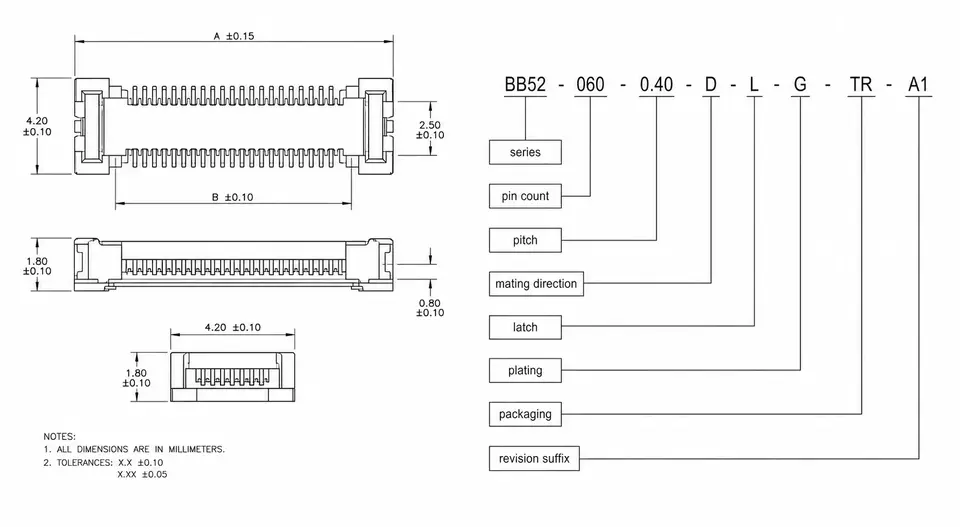
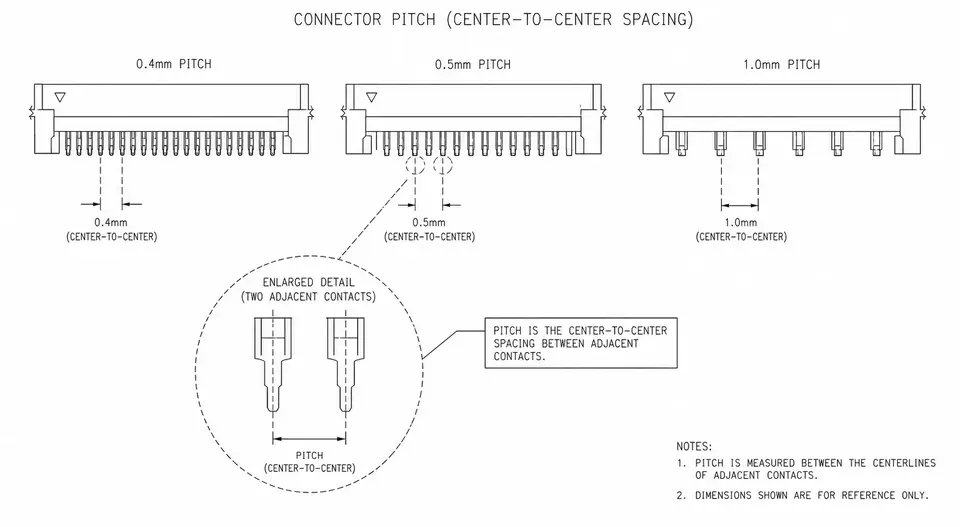
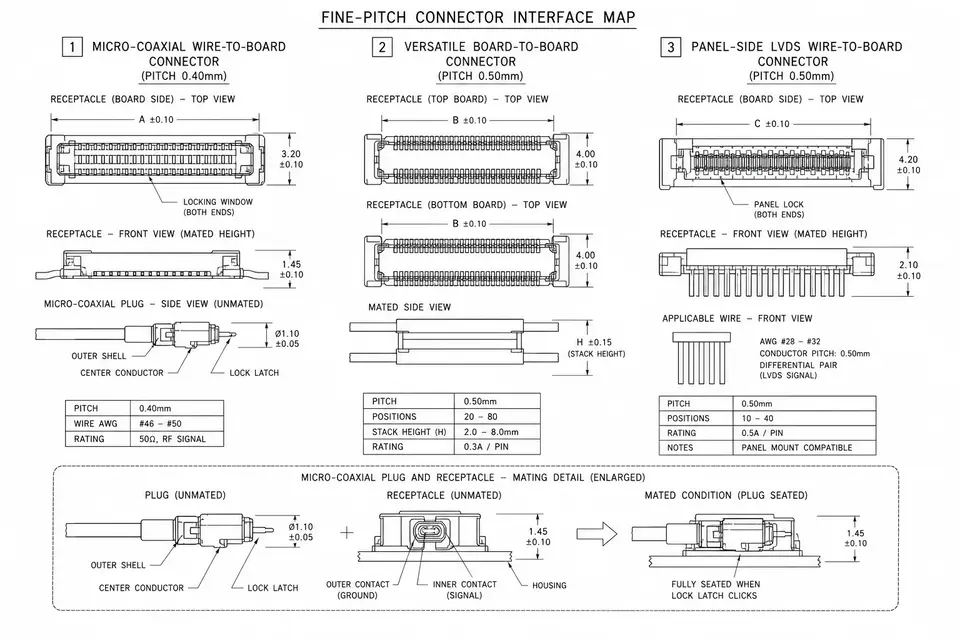
The interface map helps you locate a direction fast, but the part number is settled by the two authorities that count: the drawing and the original manufacturer's catalog. For how to take a connector part number apart, see How to Read Connector Part Numbers; for why pitch is such a pivotal parameter, see What Is Connector Pitch.
Use build-to-print manufacturing to map the approved connector system to preparation and termination checkpoints, and electrical test planning to define wire-map and short/open release evidence.
Trademark & Brand Notice
I-PEX® is a registered trademark of I-PEX Inc.; CABLINE and MHF are its connector product series identifiers. JAE™ is a trademark of Japan Aviation Electronics Industry, Ltd.; the FI series is its connector product series identifier. Hirose™ is a trademark of Hirose Electric Co., Ltd.; the DF series and U.FL are its connector product series identifiers. These names are used solely to identify the mating interface direction. The products referenced in this article are cable assemblies independently designed and manufactured by EDPcable, which is not affiliated with, authorized by, distributed by, or otherwise related to the respective owners above. When a customer drawing or BOM has already specified a given interface system, we provide custom cable assembly manufacturing built to be compatible with that interface; final delivery is governed by the drawings, samples, and engineering definitions confirmed by both parties.