What is the difference between a cable assembly and a wire harness?
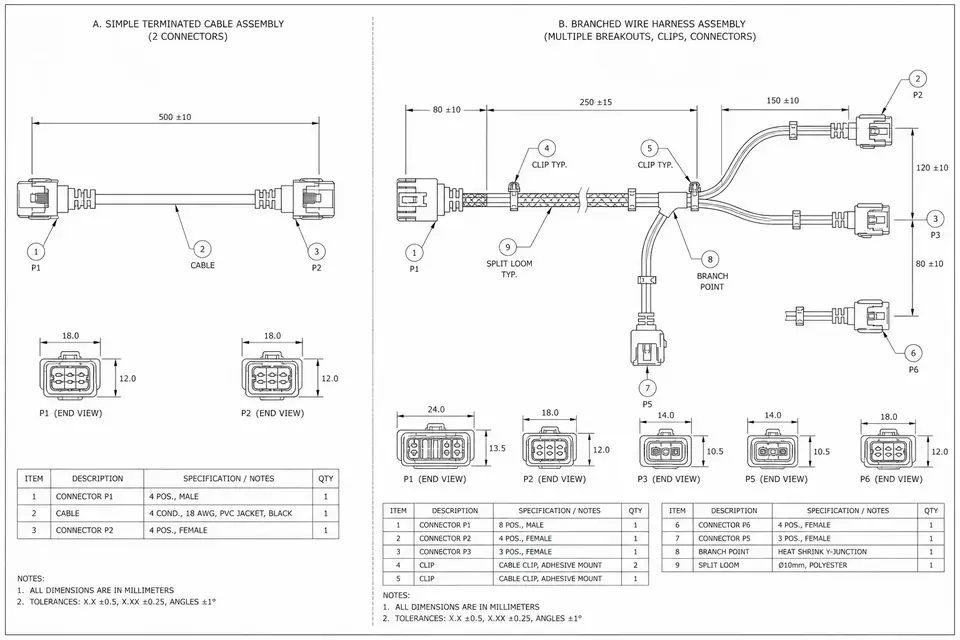
A cable assembly usually starts with a cable or cable-based construction and adds defined terminations. A wire harness usually organizes individual wires or cables into a routing network with defined branches, connectors and mounting points. This is a useful design distinction, not an absolute rule about size, jacket thickness or number of ends.
The IPC standards overview explains that cable and wire harness terms are used interchangeably for the purposes of IPC/WHMA-A-620. In an RFQ, describe the structure and acceptance requirements instead of relying on the label alone. An overmold or outer jacket does not establish a sealed assembly rating without the corresponding complete-assembly evidence.
Differences that change the drawing and quotation
| Decision | Cable assembly tendency | Wire harness tendency | What the RFQ must close |
|---|---|---|---|
| Organization | Cable-based connection | Routed and branched network | Actual topology |
| Dimensions | End-to-end and exposed cable lengths | Segment and branch lengths | Reference points and tolerances |
| Materials | Cable construction plus terminations | Wire/cable schedule plus grouping | Exact BOM and permitted alternatives |
| Routing | Defined path and end orientation | Branch directions and mounting locations | Installed geometry |
| Tooling | Depends on contacts, cable and production method | May include routing fixtures | Process and fixture needs |
| Verification | Drawing-specific | Drawing-specific | Map, conditions and acceptance sources |
| Maintenance | Assembly or approved part replacement | Branch access or approved repair approach | Service requirements |
Neither product name determines cost or qualification. Connector availability, termination count, manual operations, fixtures, test time and quantity can all change the quotation. Compare offers against the same controlled drawing and delivery scope.
Two layouts and how to describe them
For a point-to-point display cable, show connector A and B, the cable reference, orientation at each end and length between specified datums. Add the signal map, shield/ground treatment, any required accessories and the installed route. The short phrase “display cable” does not identify a substitute for those inputs.
For a sensor interconnect with one trunk and three branches, show the trunk-to-branch junctions, each segment length and exit direction, connector IDs and labels. Define every endpoint in the electrical map; do not expect a supplier to infer shared grounds, splices or unused contacts from the sketch.
These are illustrative configurations, not tested customer projects. A multi-core trunk with breakout wires may reasonably be called a cable assembly, harness or both. What matters for review is whether the supplier can identify and build every segment and connection.
When each approach is useful
Consider a cable-based assembly when the project centers on a defined connection with specific cable construction and finished ends. Consider a harness layout when the installation centers on distributing conductors to several destinations and controlling branches and mounting. If both features are present, describe both in one controlled package rather than forcing a naming decision.
Protection, motion, thermal conditions and signal performance must be specified for the actual design. Neither “harness” nor “assembly” proves outdoor suitability, ingress protection, medical suitability or a lower failure rate.
RFQ checklist: turn the layout into build inputs
- Provide the drawing number, revision, BOM and complete connector/contact/cable numbers.
- Label endpoints, splices and branches; dimension segment lengths, exits, orientation and mounting datums.
- Supply the complete point-to-point map, including supplies, returns, shields and intentionally unused positions.
- Define voltage, current, signal requirements, motion and environmental conditions using their controlling design sources.
- Specify release tests and acceptance criteria. Opens, shorts, map, insulation resistance or dielectric tests are selected by the design; do not prescribe a high-voltage test merely from the product name.
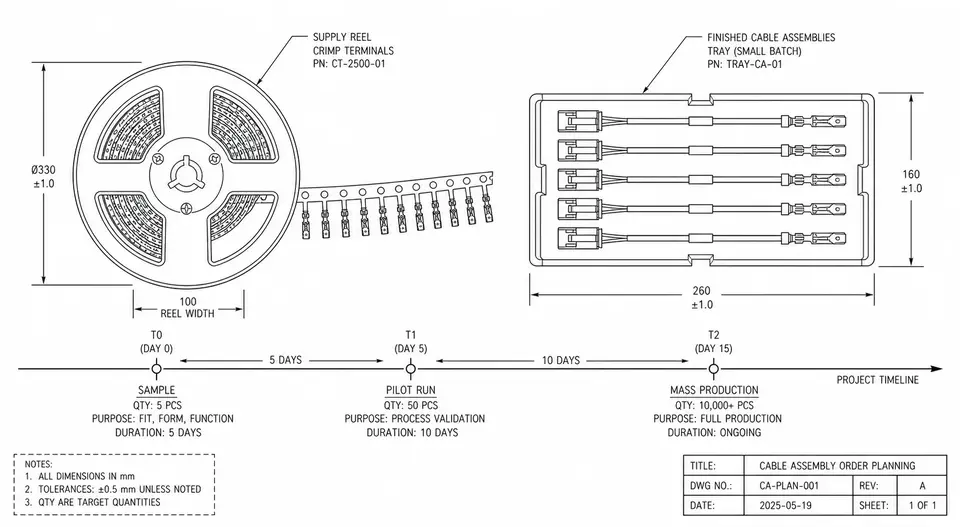
- State sample and production quantities, documentation, packaging and change-control requirements.
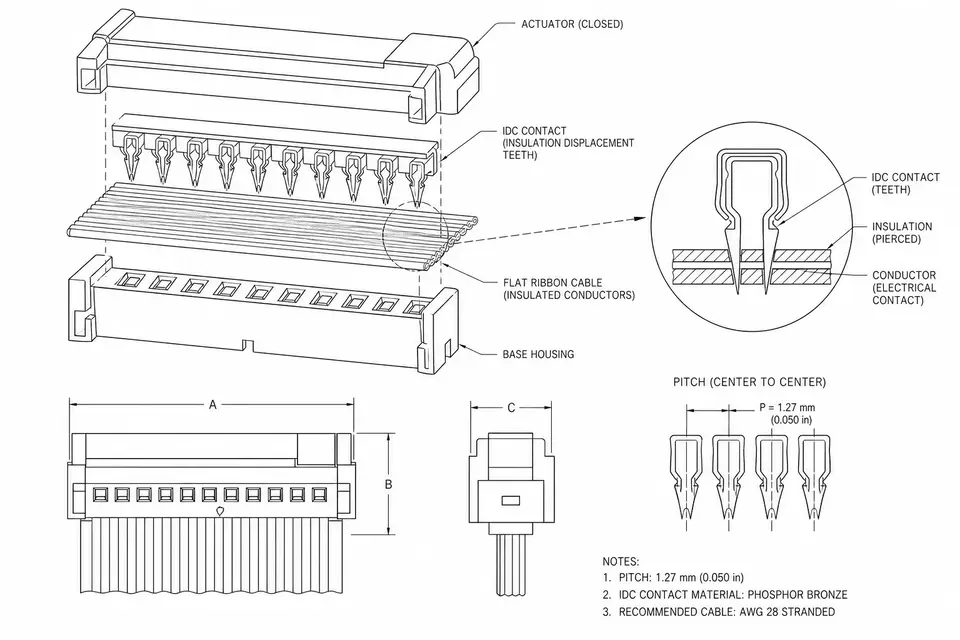
Use custom cable assemblies to start a drawing review, IDC assemblies for ribbon-based layouts and micro medical harnesses for that application discussion. The application label is not evidence of device qualification.
Verification follows the map and installed use
Electrical test planning defines mapping and electrical release checks. Validate branch placement and dimensions against the installation model, then test any specified retention, motion, environment or channel performance. Keep the limits, sampling plan and required records in the approved test plan. A simple two-end assembly can need demanding tests; a large harness does not automatically call for a different electrical method.