Confirm the Minimum Order for the Finished Assembly
There is no universal cable assembly MOQ or delivery period. Ask for the minimum quantity per assembly part number and revision, then identify the condition that creates it. A price break, a component purchase multiple and a minimum shipment quantity describe different things. Combining them into one number makes a quote difficult to compare.
A manufacturer reel does not always force the buyer to order that many finished cables. DigiKey's packaging guide distinguishes full reels from smaller cut-tape quantities for supported parts. That is a sourcing option, not proof that every connector is available in any quantity or suitable for the intended feed equipment. Confirm the exact manufacturer part number, approved source, packaging and stock allocation.
WEIPU's FAQ also distinguishes standard-product ordering from its project-specific cable assembly MOQ. These policies belong to that supplier; they are not an EDPcable quantity or delivery commitment.
Ask for These Six Separate Quote Answers
| Item | Ask for | Hold if |
|---|---|---|
| MOQ | Per part and revision | Mixed lots not approved |
| Parts | Pack size and stock source | Stock not checked |
| Leftovers | Amount, owner and use | Liability not agreed |
| Setup | Fees and tool reuse | New tools not priced |
| Samples | Build revision and checks | Changes not recorded |
| Delivery | Start, ship date and transit | Ship date used as arrival |
Use the same drawing, test scope and delivery basis for supplier comparisons. A smaller order may still need a setup fee; paying that separately does not guarantee the material constraint disappears. Request sample, pilot and recurring-production prices separately rather than extrapolating one from the other.
Calculate Material Exposure Before Increasing the Order
Here is a planning example, not a supplier quote. Suppose one approved contact is used twice per assembly, the requested lot is 100 assemblies, and a confirmed purchase package contains 500 contacts. The nominal build consumes 200 contacts, leaving 300 before setup consumption and rejects. Those 300 are a material decision, not automatically a requirement to buy 150 additional finished cables.
Ask whether smaller approved packaging or existing allocated stock is available. If the full package must be purchased, record who pays for and owns the remainder, which revision can consume it, and how it will be stored or disposed of. The calculation must use the actual BOM usage and process allowance; do not silently assume zero setup loss. If both cable ends use different contacts, calculate each line separately.
Build a Milestone Plan with Explicit Dependencies
Map drawing release, component readiness, tooling readiness, sample approval, production slot, agreed tests, quality release and shipment. Some procurement and tooling work may overlap after the necessary design inputs are released; some work must wait for approval. Ask the supplier to show those dependencies instead of simply adding every phase duration.
Epec's delivery guidance ties its production timing to quotation agreement and approved production drawings. For your own quote, get the precise start event in writing, specify working or calendar days, and distinguish an estimated schedule from confirmed material and capacity reservations. Record customer approval deadlines too: an unanswered pinout question can move the build even when components are ready.
Sample approval confirms only the stated sample scope. A hand-built sample, temporary alternate or different fixture may need additional production review. Keep deviations visible. Routine continuity inspection and application qualification are separate activities; define the required test method, acceptance limits, report and responsible party rather than assuming one replaces the other.
Reduce Waiting Without Changing the Required Assembly
- Complete the drawing, BOM, mating interface and pinout before requesting a firm schedule. Use the RFQ guide and drawing checklist to close missing inputs.
- Identify long-lead lines early. Consider a standard stocked part only after engineering approves its fit, electrical performance and termination process; similar appearance is insufficient.
- Discuss material reservations or scheduled releases when demand is credible. Agree quantity, ownership, expiry and cancellation exposure before purchasing ahead of demand. A forecast alone is not a reservation.
- Ask for a first shipment and remaining-lot dates if production capacity permits. Each shipment still needs its agreed release checks; splitting delivery does not manufacture missing components or shorten unfinished qualification.
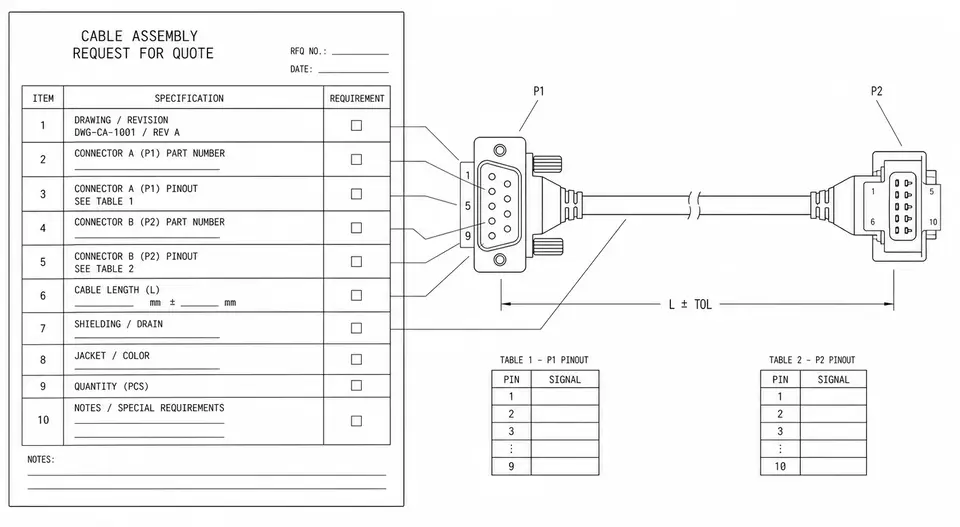
For a custom cable assembly enquiry, send the revision-controlled drawing/BOM, sample and production quantities, forecast confidence, needed-at-site date, destination, inspection/report scope and permitted alternatives. Ask the response to identify open assumptions and the next decision needed from you.
Order-Planning Line Drawing
The existing schematic illustrates component packaging and sample/pilot/production stages. Its part numbers, dimensions, quantities and day labels are illustrative, not purchasing specifications or promised delivery dates.
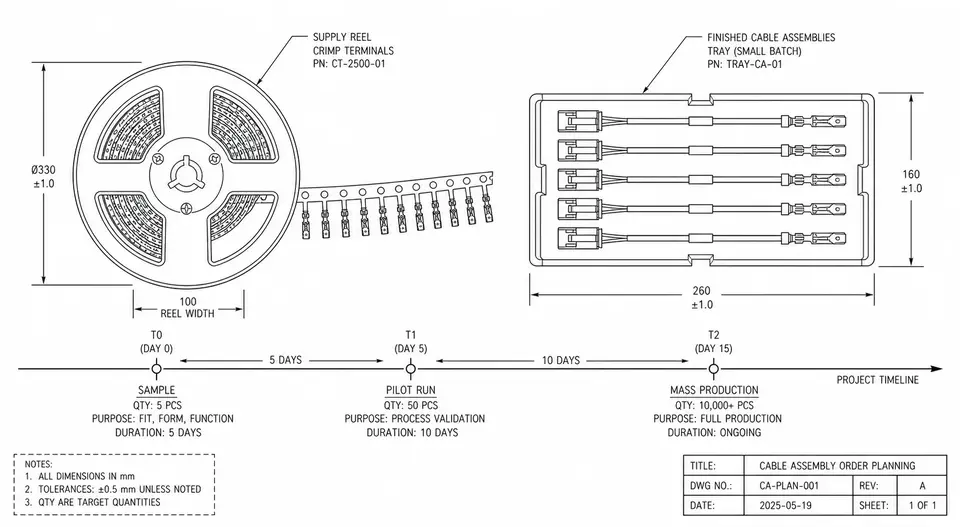
Open the complete line drawing to read its small callouts.
Related Pages and Reference Scope
- Cable assembly vs wire harness clarifies the assembly definition before an RFQ.
- DigiKey supports the packaging distinction; Epec supports the drawing-approval timing boundary; WEIPU illustrates supplier-specific MOQ policies. Their pricing, delivery promises and product qualifications do not transfer to this project.